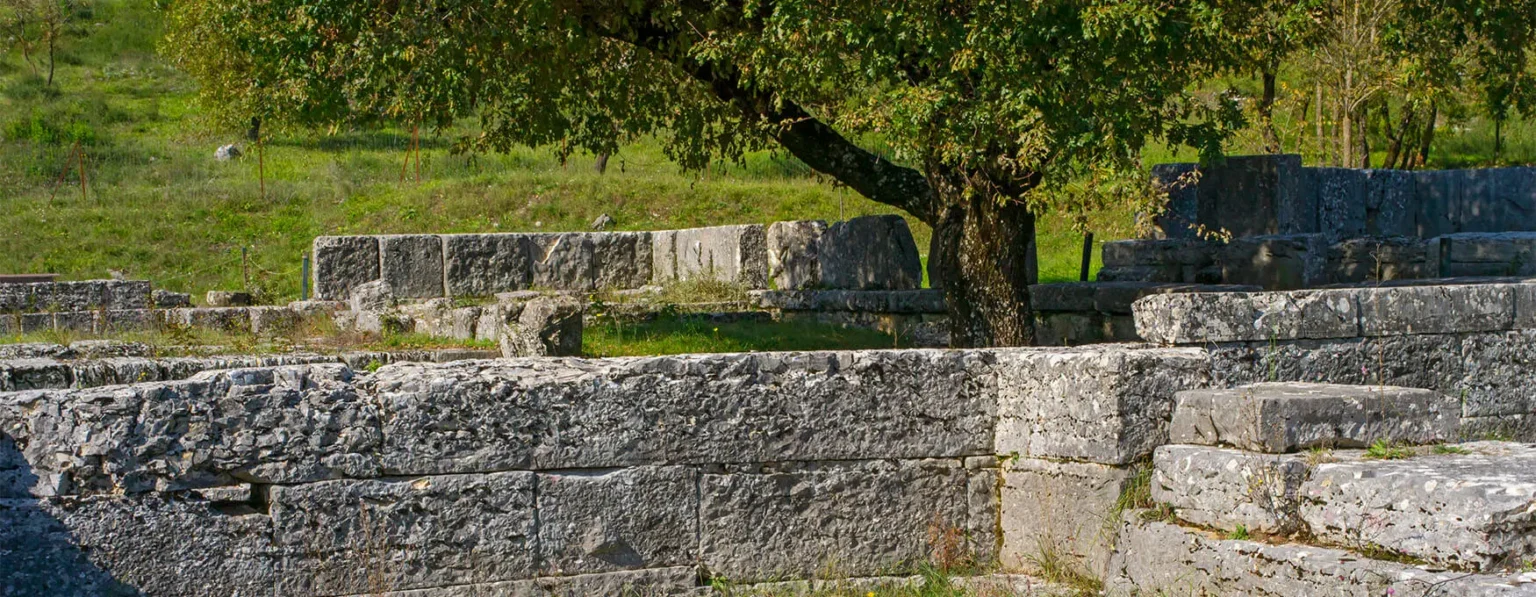
Offerings to the divine couple, Zeus and Dione, date back to the 8th century BC. These included jewelry, weapons, figurines, and many bronze tripods. Although many religious buildings and other constructions were erected in the area after the 4th century BC, the sanctuary remained open-air, likely due to its symbolism and its connection to the goddess Gaia. The sacred oak tree was always surrounded by bronze tripods, forming some kind of enclosure. These bronze tripods were dedicated by the faithful, who presumably acquired them from local metallurgists, thus contributing significantly to the region’s economy. As the influence of the oracle waned, partly due to the ancient myths of the Greek origin and the region’s difficult terrain, and because visitors consulted it mostly for personal rather than state matters, the Oracle of Delphi became the most important in terms of both hierarchy and visitation, providing prophecies for state matters and playing a significant role in the political and diplomatic history of ancient societies.
The Oracle of Dodona
The Sacred Shrine of Antiquity
The region of Dodona, according to tradition, got its name either from Dodona, the son of Zeus and Europa (Sophocles, Trachiniae 172), or from the nymph Dodona, daughter of Oceanus and Tethys, as mentioned by Stephanus of Byzantium. The Oracle of Dodona (Chressterion of Dodona) is located in the northwestern part of Greece, in Epirus, southwest of Ioannina and east of the Tómaros mountain range, 600 meters above sea level, and is mainly accessible from the coastal areas of Thesprotia. It was possibly the oldest and most significant oracle of early antiquity, operating possibly since the second millennium BC, but soon became second in importance after the Oracle of Delphi. In the early 3rd century BC, King Pyrrhus turned Dodona into the religious capital of his region by constructing a series of important buildings around the oracle, such as the temple of Dione.
Although it gradually lost its prestige, especially after the first destruction in 219 BC by the Aetolians, who, under Dorimachus of Trichon, burned down the sanctuary (Polybius, Histories IV.67.3), it was rebuilt and remained a popular destination until the rise of Christianity. In 392 AD, during the reign of Emperor Theodosius, the oracle ceased to operate, the temple was closed, along with all other pagan temples, and the sacred oak tree near the altar was felled. It is worth noting that, according to Apollonius of Rhodes, the sacred oaks of Dodona were used to construct the keel of the Argo, whose prophetic powers helped the Argonauts in their difficult journey to obtain the Golden Fleece.
Divine Origins
The Oracle of Dodona was originally dedicated to Mother Earth (Gaia), who in this region was also called Dione. Later, the sanctuary was dedicated to the divine couple, Zeus and Dione. During the early historical periods, the oracle was an open-air sanctuary, surrounded by a sacred grove of “divine” oaks, with a spring dedicated to Zeus nearby, possibly used for necessary purification rituals. In Homeric epics, Zeus of Dodona is also referred to as Pelasgian, while Herodotus mentions him as Zeus Naios, associating him with the Naiads, the earth, and fertility.
Aristotle (in Meteorologica) considered the area of Dodona to be the cradle of the Greeks, equating the region with the homeland of Hellen, the son of Deucalion, and connecting the region of Dodona and the Acheloos river with the myth of the deluge during Deucalion’s time. Following this tradition, Plutarch attributes the establishment of the oracle and the worship of Zeus in Dodona to Deucalion and Pyrrha, with the probable date being shortly after the flood.
Ancient Sources
From Homeric epics, we learn that the oracle was dedicated to Zeus, the king of Dodona, the god of the Pelasgians, whose priests were called Selloi or Elloi, with possible connections to Hellen. According to the epics, the priests of Zeus were barefoot and slept on the ground beneath the sacred oak, which allows us to hypothesize the open-air character of the oracle and its direct connection with the forces of the earth and fertility. The temple and surrounding buildings were gradually constructed in the following centuries (from the 4th century BC onward).
According to Herodotus (2.55-7), the priestesses of the oracle were also the grey-haired Peleiades, with references to the peleia (dove), one of the black doves that came from Thebes in Egypt to Dodona. Upon sitting on the sacred oak, it uttered a human voice and indicated the area as sacred. From this and other sources, we also learn that at Dodona, oracles were given through the interpretation of the rustling of the oak leaves, the cooing of sacred doves, the flight of birds that nested in the oaks, the murmur of waters from the sacred spring near the altar, or the sound of metallic objects around the altar or possibly hanging from the sacred trees.
Offerings and Precedence