Half-day excursions
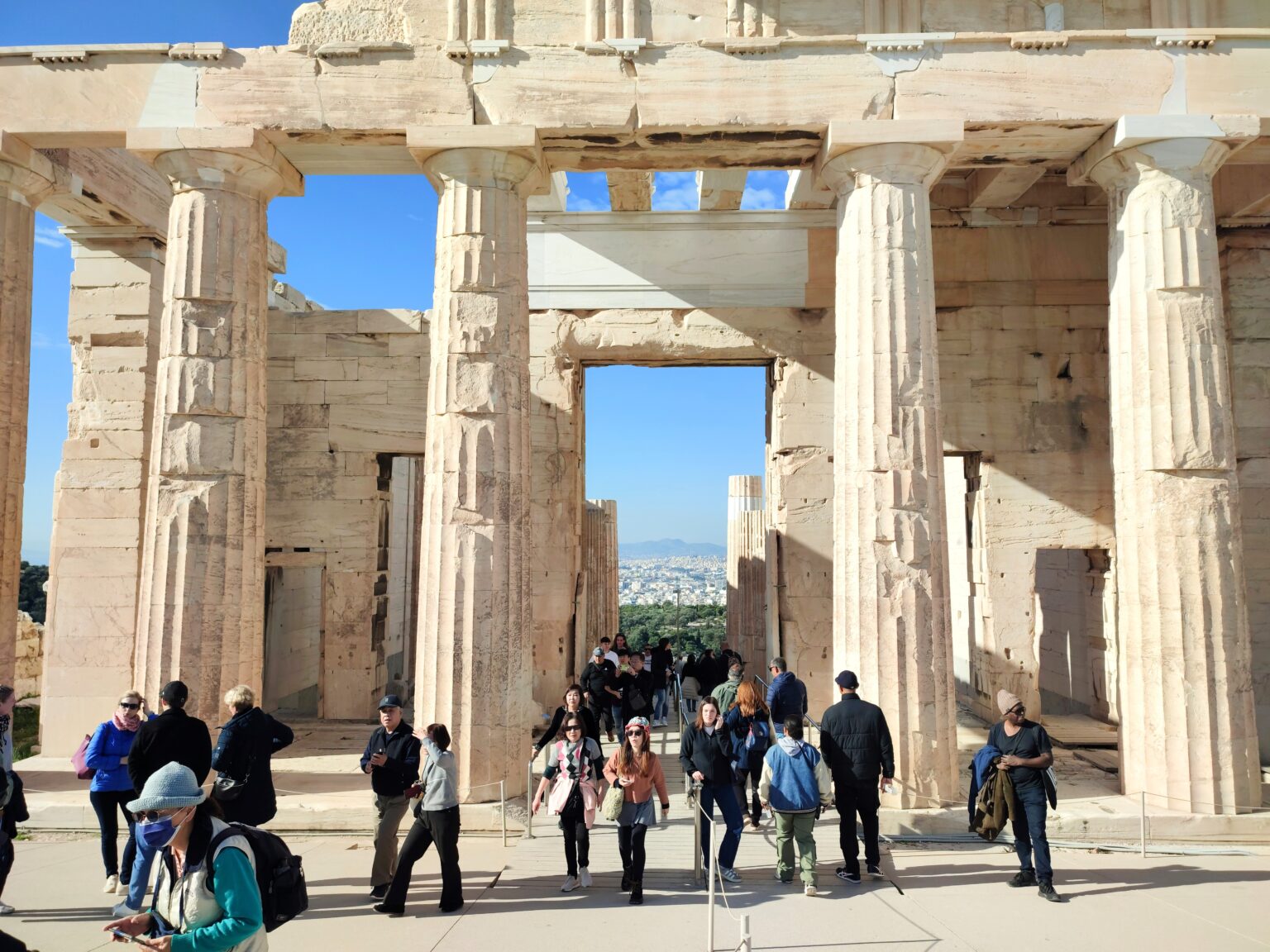
The Propylaea of the Acropolis of Athens were built on the western side of the rock, in the place where the gate of the fortification of the Mycenaean acropolis was located. Around the middle of the 6th century BC, during the time of the Peisistratids, and while the area had already been transformed into a sanctuary dedicated to the goddess Athena, the first Propylaea was constructed. A new Propylaea was built between 510–480 BC but was destroyed by the Persians in 480 BC.
After the Persian destruction, it was repaired or rebuilt during the fortification program of the Acropolis, under Themistocles and Cimon. The monumental Propylaea that visitors see today are part of the grand architectural program carried out on the Acropolis by Pericles. They were built between 437–432 BC, after the completion of the Parthenon, following the plans of the architect Mnesicles. The initial design of the building was innovative both architecturally and artistically, but it was never completed in its entirety.
The structure is primarily made of Pentelic marble and is divided into three sections. The central rectangular part is the main Propylaea. On both the eastern and western facades, there are two Doric colonnades, with a transverse wall in between, featuring five doors. The passage to the Acropolis was through the central door, flanked by three Ionic columns on each side, between the western colonnade and the transverse wall. The central structure follows the slope of the ground, and the eastern colonnade is at a higher elevation than the western one, with the same slope applied to the pedimental roof. The two side structures were lower. The issue of the terrain’s slope was also addressed inside the building, with steps placed at the front and transverse wall.
The northern wing of the Propylaea consists of a room, known from the travel account of Pausanias as the “Pinakotheke” (1.22.6), because it was decorated with paintings, including works by the painters Polygnotus and Aglaophon. In front of it is a small Doric colonnade with three columns, and its entrance was through a door flanked by two windows. According to some scholars, this room was a space for rest or dining for visitors to the Acropolis, and it is speculated that there were couches inside.
The southern wing of the Propylaea was initially designed to be similar to the northern one; however, the existence of the earlier Temple of Athena Nike forced the architect to alter the design. Therefore, only a single colonnade was built, corresponding to the northern one, consisting of three columns. From its western side, it was possible to access the Temple of Athena Nike. The original plan of the building seems to have included side rooms on the eastern side, but these were never constructed.
The form of the Propylaea remained unchanged until the early Christian period (4th–7th century AD), when the southern wing was converted into a church. In the 10th century, the central part also functioned as a church dedicated to the Archangels. During the Frankish occupation (13th–14th century), the Propylaea served as the residence of the Frankish ruler. At the same time, to strengthen the Acropolis’ fortifications, a tower was built on the right wing of the building, known as the “Koulas,” which no longer exists today.
During the Ottoman period (1458–1830), the Propylaea became the seat of the Turkish commander. The central building was used as a gunpowder magazine, which led to the first major destruction of the monument when it exploded in 1640. After Greece’s liberation from the Ottomans, medieval and Ottoman additions were demolished, and excavations were conducted in the area of the Propylaea.