Half-Day Excursions
The Sanctuary of the Goddess Demeter and Her Daughter Persephone
The Sanctuary of Eleusis was, for centuries, one of the most important religious centers of antiquity. In this area, the worship of the goddess Demeter and her daughter Persephone developed, relating to agriculture, vegetation, fertility, and the regeneration of nature and life.
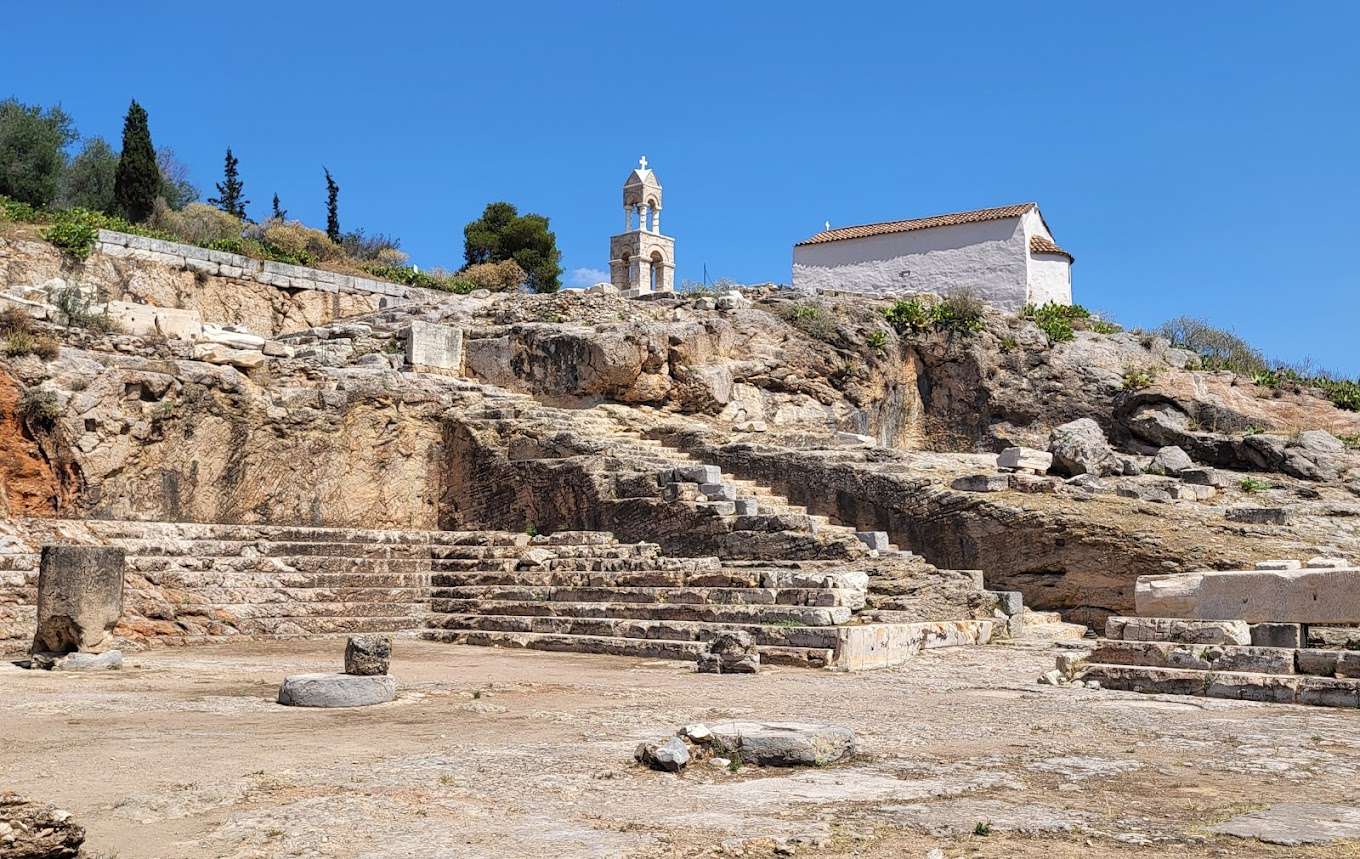
The organized archaeological site extends today on the slopes of the hill of the ancient acropolis, on which stands the small church of Panagia Mesosporitissa.
Tour of the Eleusis Archaeological Site
The tour of the monuments begins at the Courtyard, where the worshippers gathered upon their arrival at the Sanctuary. At the northern end, the Sacred Way terminated, the most important road artery connecting Eleusis with Athens, and which was followed by the procession of the initiates during the Eleusinian Mysteries.
The Processional Way was the continuation of the Sacred Way within the Sanctuary and led from the Little Propylea to the Telesterion. In Roman times, this road was paved with marble slabs. On both sides of the road, there were bases carrying statues and other dedications, as well as a stepped platform (12a) carved into the rock, where the worshippers observed some of the rituals of the Eleusinian Mysteries.
At the end of the Processional Way is the Telesterion, where the religious ceremonies took place. The oldest remains date back to the Mycenaean period and belong to a rectangular, megaron-shaped building. On the same site, in the second half of the 6th century BC, a nearly square hall was built with three entrances and stepped seating. In Classical times, the size of the hall was increased, and it is estimated that it could hold 5,000 standing spectators. In the center, there was the “Palace” and the throne of the Hierophant. At the end of the 4th century BC, a Doric-style stoa with marble columns (Philoneian Stoa) was added to the eastern façade.
The Great Propylea is the magnificent entrance built during the Roman imperial period, marking the southern side of the Courtyard. It is almost a replica of the central section of the Propylea of the Acropolis. It consists of two propylea with six Doric columns on the façade and a stoa in the longitudinal axis with six Ionic columns. The pediment of the northern façade was decorated with a relief bust of an emperor, probably Marcus Aurelius, who is credited with completing the construction.
A U-shaped stoa defined the western and northern sides of the Courtyard up to the Sacred Way, while a smaller stoa closed the courtyard on the eastern side. Next to the smaller stoa was built a Fountain. From this 2nd-century AD building, the basin of the fountain in the shape of a “P” is preserved, as well as the white marble platform with eight basin-like cavities where water flowed from eight fountains.
In the middle of the Courtyard, the base of the Roman Temple of Propylaia Artemis and Poseidon, as well as the remains of two altars dedicated to them, are preserved, along with the remains of the pedestal for the statue of Poseidon.
In the auxiliary area of the Sanctuary, there are the House of the Heralds, an underground Roman-era reservoir, and the silos, where the “first fruits” from agricultural production, offered by all the cities as a kind of tribute, were collected.
Within the archaeological site is the Archaeological Museum, designed by the architect Ioannis Moussis, which was completed in 1890. It hosts important finds from the excavations in the Sanctuary and the cemeteries of the ancient city of Eleusis.