Half-Day excursions
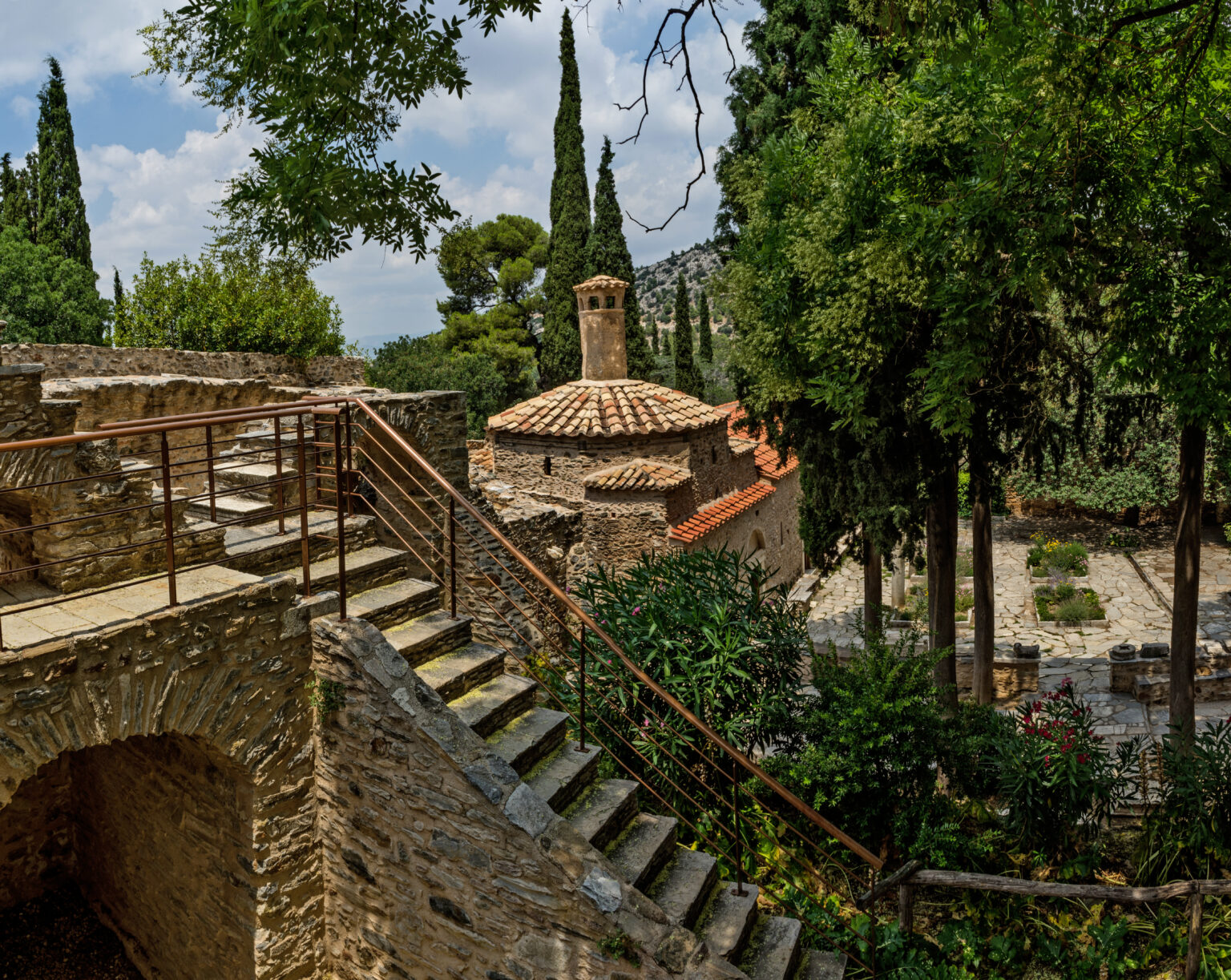
The Kaisariani Monastery is a medieval church in Attica. It is located on Mount Hymettus, in the valley almost at the middle of its western slope. In the past, the area was forested and full of olive trees, and near the monastery, there was a spring with abundant cold water. This spring is probably the one called “Kallia” by ancient Greek and Roman poets.
A little further up from this point, the site in antiquity was dedicated to Aphrodite and was named “Kyllou Pira,” today commonly known as “Kallopoula.” In the early Christian centuries, a Christian temple was founded near the spring, and the building materials of this temple were later used in the construction of surrounding buildings. The present church was built in the 11th century and is dedicated to the Entrance of the Theotokos. Around this church, the area that is now known as Kaisariani developed.
For the first time, Kaisariani is mentioned in a letter by the Metropolitan of Athens, Michael Akouminatos, in the early 13th century.
The monastery was most likely built during the Byzantine period, around 1100, which is the construction date of the preserved church (the katholikon of the monastery). However, the area has a longer history as a religious site: in antiquity, it was probably a space dedicated to Aphrodite. Ruins of a large basilica are located to the west, near a smaller church built between the 10th and 11th centuries.
The monastery is mentioned by Pope Innocent III after the Fourth Crusade, but it seems that it remained under Orthodox control, while other churches and monasteries had been seized by Latin clergy. Another, now abandoned, single-aisled church was built to the southwest during the Frankish rule. When the Ottomans captured Attica in 1458, Sultan Mehmed II visited the monastery, and according to Jacobus Spohn (1675), a French doctor from Lyon, he was given the key to the city.
In 1678, Patriarch Dionysius IV designated the monastery as stavropegic, meaning it was free and independent from the archdiocese: its only obligation was to conduct funeral rites. Later, in 1792, Patriarch Neophytos VII revoked the privileges of the monastery, which was once again under the jurisdiction of the Archdiocese of Athens. From 1824 onwards, the monastery “suffered deplorable treatment. What had once played an important role in the enlightenment of humanity and the salvation of souls, was now a palace for cows, poultry, and horses.”
The monastery was closed in 1833, during Bavarian rule, by a decree from Georg Ludwig von Maurer, due to having fewer than six monks.
During its heyday, it hosted numerous significant spiritual figures of the time, such as Theophanes in 1566, Ioannis Dorianos in 1675, the abbot Ezekiel Stefanakis, who was knowledgeable in Greek literature and history, particularly Platonic philosophy. From 1722 to 1728, Theophanes Kavallaris held grammar and science lessons at the site.
The monastery’s library was renowned and likely contained records from ancient libraries. According to the local elders of the time, “the manuscripts were sold to the English as parchments, while the remaining archives were used in the kitchens of the metropolis.” During the Fall of Athens to the Turks, the manuscripts were transferred to the Acropolis and used to light fuses.
The cultivable areas around the monastery, as well as other properties such as the Church of St. John the Baptist, located along the road to Kaisariani or those in Anavyssos, belonged to the monastery.
The monks’ income was supported by the production of olive trees, vineyards, and beehives. In a letter dated 1209, during the Frankish rule, Michael Choniates mentions that “the production from the beehives was given to the abbot of Kaisariani Monastery. However, four years later, he complains that he did not receive any income from the monastery: the abbot’s excuse was that the beehives were destroyed.” The monks were also renowned for preparing medicines from various herbs.
A high wall surrounds the buildings, the katholikon (main church), the dining hall, the bathhouse, and the cells, thus they are still quite protected. The original design included two entrances: the main entrance on the eastern side and a larger one on the opposite side.
The monastery was built on the ruins of an older building. The monastery’s layout was drawn in 1745 by a Russian pilgrim named Barsky, depicting the following buildings: the katholikon on the eastern side of the wall surrounding the monastery, the bathhouse on the southern side, the monks’ cells, which border the Benizelos Tower, and the dining hall on the western wing. In addition to the vegetable garden on the southwestern side of the monastery, it depicts the monks’ cemetery and a newer church.
The katholikon follows the typical Byzantine style, with semi-hexagonal apses. However, the narthex and the murals of the katholikon date to the Ottoman period, as do most of the monastery’s buildings, with the exception of the olive press, which was originally a bathhouse, and appears to be contemporary with the katholikon. The buildings are scattered in a courtyard. The katholikon was located on the eastern side, the dining hall and kitchen on the western side, as well as the bathhouse, which was converted into the monastery’s olive press during the Ottoman period, and finally, the monks’ cells, in front of which was an open colonnade.
The katholikon is dedicated to the Entrance of the Theotokos and had a cross-shaped structure, faithful to the Greek tradition, according to M. Sotiropoulos, or a semi-circular tetraclitic design according to Anastasios Orlandos.
The entrance to the church was located on the western side without being separated by a narthex. There was also an entrance on the northern side, with a marble threshold and a Roman inscription. The narthex, which was definitely built before 1602, is a vaulted ceiling with a dome and a skylight in the middle.
The Kaisariani bathhouse, along with those preserved at the Monastery of Daphni and Derbenosalesi of Kithairona, are examples of 11th-century architecture, which confirms the belief that monks often used bathhouse spaces. The hot water was used to heat the cells, the dining hall, and elsewhere.
The buildings were on the left side of the eastern entrance, opposite the southern side of the katholikon, and surrounded a natural spring. They were covered by a hemispherical vaulted roof, supported by four columns. These small columns, which supported the protective roof, were destroyed when the space was converted into an olive press. The preserved containers demonstrate this transformation.
The major earthquakes of 1981 caused severe damage to parts of the monastery complex, specifically to the bathhouse and the dining hall. Eleven years later, the Minister of Culture appointed the Philodassiki Union of Athens, a non-governmental organization, to oversee the restoration of the bathhouse under the supervision of the First Byzantine and Post-Byzantine Antiquities Directorate. Before the restoration was completed, the 1999 earthquake interrupted the work once again, this time for many years.
A subsequent Minister of Culture signed the execution of a new study, designed by the Directorate of Byzantine and Post-Byzantine Monuments of the Ministry of Culture, in collaboration with Philodassiki, under the condition that they would continue to provide financial support for the project. Despite this, the work continued until it was interrupted again, indefinitely this time, for technical reasons unrelated to Philodassiki.
The dining hall and kitchen are located in an independent building on the western side of the wall, opposite the katholikon. The dining hall is a long rectangular vaulted room, divided into two spaces. The kitchen on the southern side of the dining hall is square-shaped with a vaulted ceiling, where a chimney is located. The hearth is in the center of the room, surrounded by a step built into the base of the four walls.
The monks’ cells, along with the Benizelos Tower, occupy almost the entire southern side of the garden.
In collaboration with the Archaeological Service, Philodassiki restored the Kaisariani Monastery complex between 1952 and 1955. The association oversaw and financed all the work. Tasos Margaritoff restored the post-Byzantine icons that were included.