Half-day Excursions
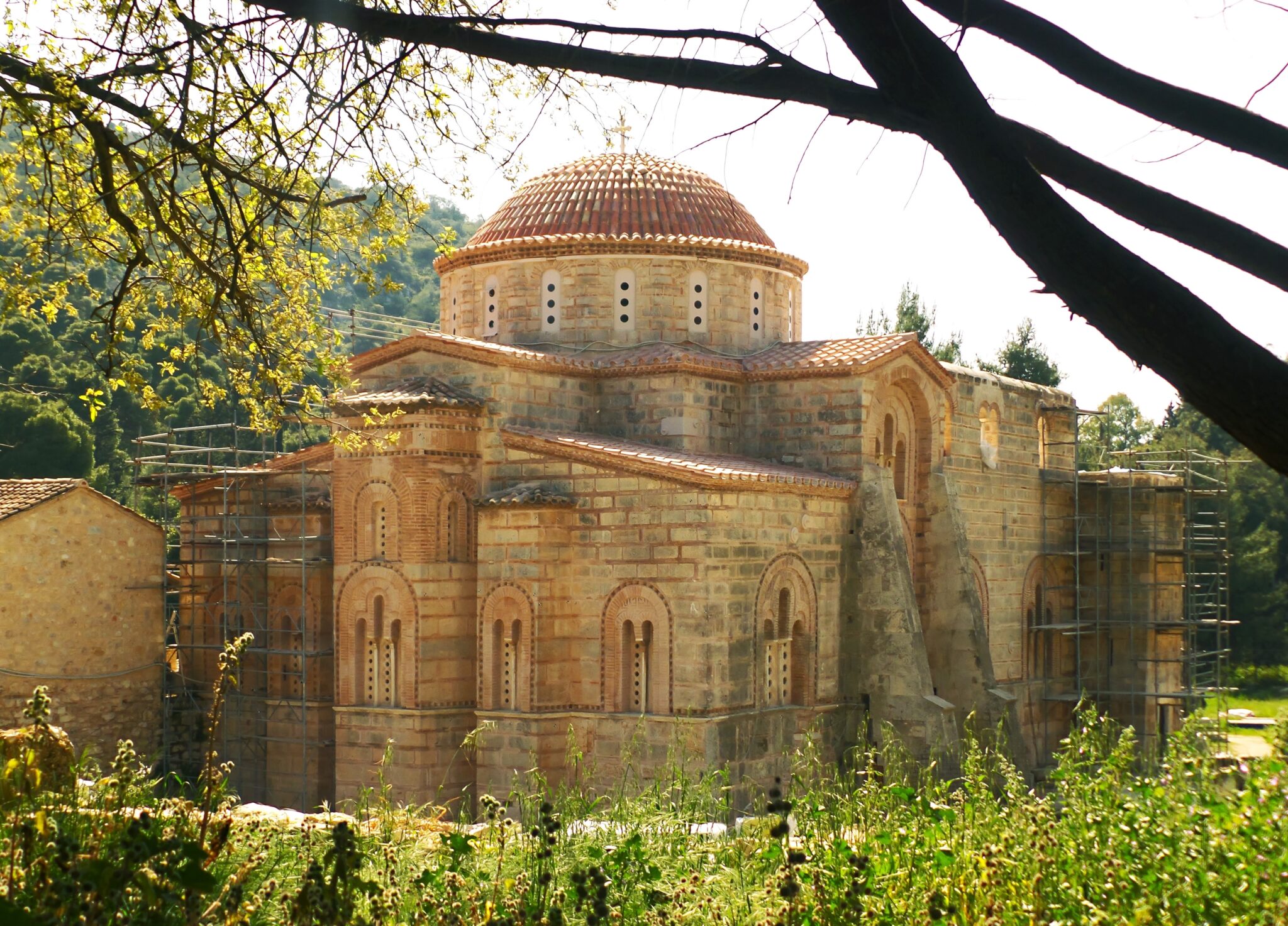
The Monastery of Daphni is located in Chaidari, on the outskirts of Mount Egaleo, on the Athens-Lavrio highway, 11 km from the center of Athens, and is built on the site where the Temple of Apollo Daphnaios once stood. Its impressive architecture and the unique mosaic decoration of its church make it one of the most remarkable monuments of Byzantine art. Since 1990, it has been a UNESCO World Heritage site. The monastery suffered significant damage in the 1999 earthquake.
The monastery was founded in the 6th century on the ruins of the temple of Apollo Daphnaios, which had been destroyed by the Goths in 395. Some of the Ionic columns from the ancient temple were reused. Today, only one column remains, while the rest were transferred to London by Lord Elgin.
The catholicon of the monastery dates back to the late 11th century and belongs to the architectural style of the octagonal cross-in-square church. In this style, the central space of the church is expanded by replacing the four columns supporting the dome with eight columns placed closer to the walls. The arrangement of the columns forms an ambulatory around the central space, preserving the cross-shaped arches on the ceiling with intervening semi-domes, characterizing the so-called composite octagonal (or “continental”) style of Middle Byzantine church architecture.
The mosaics in the catholicon are the best-preserved examples from the early period (Comnenian Dynasty, around 1100), represented by the strict and sacerdotal depiction of Christ the Pantocrator in the interior of the dome, a key feature of the Macedonian era.
After the looting of the monastery by the Crusaders in 1205, Otto de la Roche, Duke of Athens, granted it to the Cistercian monks. The French monks rebuilt the narthex, added a wall around the monastery, and made other changes until they were expelled by the Turks, when the monastery was handed back to Orthodox monks in 1458. Over the centuries, the monastery was abandoned. Restoration work began in 1888.
The name of the monastery is linked to the ancient sanctuary of Apollo Daphnaios, on which it is believed to have been built. However, there are other versions. One suggests that it was named after the abundance of laurel trees in the area, and perhaps this was also the reason for the establishment of the ancient sanctuary.
Another version associates the name with the Virgin of Daphni in Constantinople. A tradition, narrated by the elderly nun Martha around 1870 to Georgios Lambakis, states that the name and foundation of Daphni are connected to the princess Daphne. A legend of the time tells that Daphne was shipwrecked in the sea of Skaramangas but was saved along with twelve barrels full of coins. To thank the Virgin Mary, she built the monastery in her honor and buried the leftover coins in seven jars within the monastery’s perimeter.
There are many other versions from traditions, likely myths, that have arisen from the popular belief that the monastery was founded by a Byzantine emperor. One of these connects the monastery to the legend of Princess Margaronas and the noble Iberios, dating back to the 12th century.
The exact founding date of the Monastery of Daphni is not completely clear. Most researchers trace its establishment to the 6th century, during the early Christian period. During the 5th and 6th centuries, many churches were built in Athens, and several pagan temples were converted into Christian churches due to the spread of Christianity after it was declared the official religion of the Byzantine Empire by Emperor Theodosius I. To purify the ancient temples and sanctuaries, their conversion into Christian churches was enforced.
The Christian churches followed the basilica architectural style. They were elongated rectangular buildings oriented east-west, with an apse attached to the narrow eastern side. The interior was divided into three aisles (naves), separated by two rows of columns parallel to the longitudinal axis of the church (triple-nave basilicas). This is believed to have been the design of the church built in Daphni in the 6th century, on the site of the Temple of Apollo Daphnaios, which was destroyed during the Gothic invasion of Alaric in 395 AD.
There is another version, recently supported by Professor Charalambos Bouras, which suggests that the monastery was founded in the 11th century. This is based on the study of artifacts, all of which date after the 11th century. The absence of monasteries in the area south of Mount Olympus before the end of the Iconoclast period (i.e., the early 9th century) supports this version.
The dating to the 6th century was based on the sculptures that existed at the site, which, after being studied by archaeologists, were determined to belong to the Middle Byzantine period (843-1204). Some monastic cells and a defensive wall are also attributed to this early period.
The 6th-century basilica was probably demolished, and in its place was built the cross-in-square octagonal church of the 11th century. The limited excavations conducted to locate the 6th-century basilica have not yielded any results so far.
The foundation of the Monastery of Daphni, most likely around 1080, was sponsored by an unknown benefactor, as no dedicatory inscription has been found. The Constantinopolitan influence observed both in the architecture and in the mosaic decoration of the monastery’s catholicon has led researchers to conclude that the donor was a high-ranking official or perhaps an emperor who likely invited craftsmen from Constantinople.
Many researchers have linked Daphni with Emperor Basil II (976-1025) due to his admiration for the ancient city of Athens. However, the study of the architecture and decoration of the catholicon has led archaeologists to conclude that the church was built around 1080. Thus, we can simply attribute the sponsorship to one of his successors.
The Monastery of Daphni consists of the catholicon, the enclosure, the monks’ cells, the refectory, the kitchen, the bathhouse, the cistern, and a rectangular hall.
The catholicon of Daphni dominates the center of the almost square large courtyard. Its size is impressive, its architectural style is complex, and its masonry is of exceptional quality. The church belongs to the composite octagonal architectural type – it is indeed one of the most significant examples of this type in Greece. Externally, one could compare it to a large cube supporting a wide and tall dome. Internally, the dome is supported by eight quadrilateral supports (piers), four free-standing and four embedded in the walls. The octagonal designation comes from the eight supports of the dome. The piers, arranged in pairs, form four corner niches (semi-domes), bridging the corners of the square base and turning it into an octagon. The dome rests on this octagon via eight small spherical triangles formed between the arches connecting the eight supports. Octagonal churches are divided into simple and composite types. In the simple ones, the eight dome supports are embedded in the walls (engaged piers), leaving the interior of the church completely open. In the composite octagonal churches, the dome supports are set at a distance from the outer walls, creating smaller chambers around the central space. Composite octagonal churches are cross-in-square, with a broadened space under the dome. Unlike the simple octagonal ones, the cross is clearly visible both inside and outside the church. Octagonal types spread in Greece through Constantinople. The space under the dome is open and unified, and at Daphni, it is flooded with light coming from the sixteen single-light windows of the dome.
Externally, the building rises in a pyramidal shape up to the top of the dome. It is constructed using the brick-and-stone system. There are no decorative elements, and often the simple vertical brickwork is omitted. On the drum of the southern and western walls, a pseudo-architectural decoration has been identified. Generally, the ceramic decoration is quite modest, consisting mainly of dentil bands around the arches of the windows. The sculptural decoration, both inside and outside the church, is limited but extremely well-crafted. The lower part of the walls was internally covered with marble slabs (polished marble). Externally, large domes beneath the window sills form crosses.
On the western side of the church, there was a narthex, which was later attached with an external narthex in the form of an open arcade with a floor added during the 12th century. It is believed that the abbot’s residence and the library were located there. In the external narthex, traces of 12th and 13th-century frescoes have been found, while the church contains post-Byzantine frescoes (17th century).
The monastery was protected by a strong rectangular enclosure, approximately 97 meters on each side. The enclosure had a defensive character and morphology, which is particularly clear on the northern side, where the wall is well-preserved. It had a height of 8 meters, with a parapet 1.6 meters wide, an interior corridor allowing movement along the wall at a height of 6 meters. The parapet was supported by a blind arcade. The wall was crowned with battlements along its entire length, and its path was interrupted at regular intervals by square corner towers. Three of these towers are still standing today and are located on the northern side of the enclosure. The construction of the wall used limestone blocks cut into large rectangular pieces measuring 1.6 meters in length and 0.4-0.6 meters in height, connected with mortar, and often interspersed with layers of clay bricks.
The main gate of the monastery was located in the middle of the western side of the enclosure, opposite the entrance to the church. It was protected by a defensive tower rising above it and reinforced by two side bastions. To enter the monastery’s courtyard, one had to pass through a vaulted corridor, 6 meters long, which opened beneath the tower. A smaller gate was also located at the middle of the eastern side of the enclosure, and this is the entrance currently used for the monastery. The purpose of the enclosure for remote monasteries was, of course, to protect them from invaders, while for monasteries within cities, it was to protect the monks from the temptations of worldly life. The fortification of the Daphni Monastery, built 10 kilometers from Athens in a wooded, semi-mountainous area, yet frequented by travelers, merchants, soldiers, as well as robbers and bandits, seems to have served both of these purposes.
The cells where the monks rested were typically constructed attached to the inner side of the enclosure, to save space and reinforce the defensive nature of the monastery. These cells usually consisted of two floors, but often had up to four. The low doors of the cells typically opened into covered arcades, called solaris or emboles. Inside, the monastic cells contained beds and small niches for the monks’ clothes, books, and personal items.
On the northern wall of the Daphni Monastery, traces have been found suggesting the existence of cells: slots for beams supporting the wooden floor of the upper floor and niches for the monks’ personal items. On the western side of the enclosure, the cells were not attached to the wall but were located at a small distance from it, forming a narrow corridor. South of the katholikon, there is a group of cells with arcades, built around a small square courtyard. These were constructed by Cistercian monks and later modified by the Orthodox during the 16th century.
The refectories are spacious rectangular rooms with an apse on one of the two narrow sides. Here, the monks sat at long stone tables or benches arranged in parallel rows along the walls, while the abbot ate at a separate table in the apse.
In Daphni, this space is located in a long, vaulted building, 28.7 meters long, to the north of the katholikon. Its orientation was the same as the katholikon. The walls, preserved up to a height of about 1.7 meters, were constructed with materials and techniques similar to those used in the katholikon’s construction, dating the rebuilding of the refectory to the 11th century.
The monks entered the space through three double doors on the western side. The eastern side was occupied by an apse, semicircular internally and hexagonal externally. The room was vaulted with a ceiling supported by reinforcing arches along the long sides. As long as there was daylight, the space was illuminated by natural light coming from rows of windows in the long sides of the room, while lamps were used in the evening.
The circular structure attached to the northern side of the refectory was most likely the monastery’s kitchen. Monastic kitchens had a central hearth with a cooking grill and were covered by low domes with a central chimney. Niches of various sizes and shapes were carved into the walls for storing utensils.
The dome and apse, which dominate the vertical and longitudinal axes of the church building, symbolize the celestial sphere, while the lower zones represent the earthly one. Thus, the dome is occupied by an image of Christ Pantocrator, surrounded by angelic hosts and prophets. In the spherical triangles, the four Evangelists, who recorded the divine incarnation and acted as links between the earthly and heavenly realms, are depicted. The events of the incarnation, such as various incidents from the earthly life of Christ (Christological scenes), are placed in the immediately lower zone of the church, that is, in the arches, the drums of the cross arms, and the upper parts of the walls. The lower zone of the walls depicts the saints, who, together with the faithful who have come to the church, experience the vision of the divine.
The Pantocrator, “Just Judge,” in the medallion of the dome of the katholikon at the Daphni Monastery. The strictness and intensity of the gaze are largely due to the strong arched eyebrows and the dark shadows around the eyes. The relatively schematic and flat depiction of the face’s plastic values distances the image of the Pantocrator from the classicizing style seen in all the other forms. The dark, dense beard enhances the impression of severity. The large distance between the index and middle fingers on the gospel intensifies the gesture, aligning with the overall dynamic of the figure.
In the apse of the sanctuary, the Virgin Mary is depicted as Platytera. The Theotokos, the bearer of the divine incarnation, prays for the salvation of humanity and acts as a mediator between the heavenly and earthly spheres, between God and humanity. In the semi-circular part of the apse, the themes related to the Divine Liturgy typically include the Communion of the Apostles (transmission-communion) as well as various Church Fathers. In the katholikon of the Daphni Monastery, which is dedicated to the Dormition of the Theotokos, this typical pattern is followed, enriched with scenes from the life of the Virgin (Mariological scenes).
In the drum of the dome, sixteen frontally standing prophets were depicted. Their calm postures resemble ancient philosophers and orators. The classicizing notion is particularly evident in the relief modeling of some figures and in the thoughtful expressions in their eyes. However, some of the depicted prophets have stern, sharply shadowed faces, resembling the Pantocrator. The current positioning of some of the figures is not original.
The Nativity in the southeast pendentive of the Daphni Monastery’s katholikon is characterized by strong classicism, evident in the depiction of the landscape, the serene and highly plastic faces of the figures, the calm drapery of the garments, and their harmonious movements. In the four pendentives beneath the dome, the Byzantine mosaicists depicted the most significant Evangelical scenes before the Passion: the Annunciation (northeast pendentive), the Nativity (southeast pendentive), the Baptism (southwest pendentive), and the Transfiguration (northwest pendentive). All four representations have survived more or less fragmentarily. The first takes place in a single golden field (background), with no indication of the landscape. The archangel Gabriel approaches the Virgin Mary with a calm, harmonious movement, reminiscent of an ancient Greek depiction of Victory. His garments – a white robe over a dark blue tunic – are slightly pleated and follow the movement of his body. The Virgin Mary, depicted frontally, stands in front of a throne, her head slightly turned to the right. The expression on both figures is noble and serene. The angel’s wings and the garments of both figures are decorated with golden tesserae. The Nativity scene unfolds in an almost idyllic landscape. The rocky cave where the Virgin and the newborn Christ are placed, with golden reflections at the top from the glow of the star, is surrounded by low hills with limited vegetation. To the lower right, a group of sheep drinks water from a stream. The classicism in the depiction of the landscape is in complete harmony with the serene figures of the Virgin Mary and Joseph, as well as the four angels and two shepherds who fill the upper zone of the scene. Here too, the drapery is calm and follows the movements of the bodies, the gestures are harmonious, and the faces are highly plastic.
The depiction of the Virgin Mary in the strongly classical representation of the Crucifixion, with her deeply melancholic expression and graceful gesture, is notable. The harmonious bodily proportions and posture of both the Virgin Mary and John (opposite her) are derived from classical antiquity ideals. At the center of the particularly symmetrical Baptism scene, the naked form of Jesus, submerged up to his chest in the waters of the Jordan River, dominates. The naked body, clearly visible within the light blue water of the river, is delicately crafted with the use of small white and pink tesserae. The same applies to the face of Christ and the other figures in the composition. The correct proportions of the naked body, as well as its subtle movement in turning toward the Precursor on the left, resemble a classical statue. This is one of the few depictions of the Baptism where Christ is shown completely naked. To the right are two angels with their hands covered by tunics (front parts), preparing to dry Christ’s body after the baptism. The hand and foot seen at the bottom right belong to an elderly male figure, symbolizing the River Jordan.
In the Transfiguration scene, Christ is depicted within an elliptical blue and white glory, framed by a broad band of silver tesserae, standing in a relaxed frontal pose, like an ancient orator on Mount Tabor. With his right hand, he blesses, while holding a scroll in his left hand. As with the prophets on the dome drum, the figure’s model is drawn from classical sculpture. Mount Tabor is represented by a series of low hills at the lower part of the composition, where the apostles Peter, John, and James are kneeling, dazzled by the divine light. To the left and right of Christ stand the praying prophets Elijah and Moses, respectively. Despite the strongly metaphysical nature of the scene, the movements of the figures are characterized by grace, the drapery harmonizes with the restrained motion of the bodies, and the sculptural volume and plasticity of the faces are rendered in high relief.
In the small niches beneath the semi-domes, there are figures of the prophet Aaron (northeast niche, Annunciation), Saint Gregory of Akragas (southeast niche, Nativity), Saint Gregory the Wonderworker (southwest niche, Baptism), and the prophet Zechariah (northwest niche, Transfiguration). The apse of the sanctuary features a throne-bearing Virgin Mary, depicted enthroned and holding the child. The figure is largely damaged, with only its lower part remaining. The Platytera (the Virgin Mary) is surrounded by the imposing archangels Michael and Gabriel, who stand frontally in the two side niches. They wear heavy, gold-embroidered garments, stand on luxurious footstools, and their faces are serene and solemn.
On the dome of the Sanctuary, the apocalyptic scene of the Preparation of the Throne, symbolizing the Second Coming, was depicted. Unfortunately, this scene is almost completely destroyed. On the faces of the walls separating the sanctuary from the narthex, the full-length figures of the Virgin Mary holding the child (north wall) and Christ (south wall) were shown. These two representations, surrounded by small altars, are now barely preserved.
The diaconicon, located south of the sanctuary, is decorated with the figures of Saints Eleutherius, Averkos, Lawrence, and Euplus, arranged in pairs on the arches framing the cross-vaulted ceiling. The latter is decorated with a Christogram. In the diaconicon’s niche, the figure of Saint Nicholas is prominent. A similar arrangement exists on the roof of the prothesis, where Saints Sylvester, Anthimus, Stephen, and Rufus appear, with the niche occupied by John the Baptist. Saint Nicholas and John the Baptist are considered the most significant mediating figures, after the Virgin Mary, within the Christian Church. The stern faces of the Baptist and Saint Nicholas, with their piercing gaze, arched eyebrows, and dark shadows around their eyes, strongly resemble the Pantocrator and some of the prophetic figures on the dome. These are the only examples in the entire mosaic decoration of the katholikon that do not follow classical models.
The studied juxtaposition of Christological and Mariological scenes is also characteristic of the decoration of the inner narthex. Thus, in the northern section, scenes from the Passion of Christ are depicted: the Sacred Wash (largely damaged), the Last Supper (heavily damaged), and the Betrayal of Judas. The southern section of the narthex hosts scenes where the Virgin Mary is the central figure: the Prayer of Saint Anna with the Annunciation of Joachim, the Blessing of the Priests, and the Entrance of the Theotokos.
The classical simplicity and the calm, restrained sorrow of the Crucifixion scene evoke deep emotion in the viewer even today. The Virgin Mary and John stand on either side of the Crucified Christ, whose harmonious bodily proportions reflect classical ideals. Their inner passion is expressed through their deeply melancholic expressions and graceful gestures, drawing from the funerary sculptures of classical antiquity. The Virgin Mary, on the left, gestures toward Christ with her right hand while holding a small handkerchief with her left under her chin. John, on the right, leans his head toward Christ, yet turns his gaze in the opposite direction, raising his right hand upwards. The drapery is rendered with calm folds, and the figures are structured with very accurate proportions. Their relief-like plasticity is achieved through soft color tones and the avoidance of strong contrasts.
In the Resurrection, the triumphant Christ, shining with a white-golden garment, moves dynamically to the left, holding a cross. From a sarcophagus on the left, Adam and Eve emerge, while behind them stand the righteous David and Solomon, dressed in luxurious garments and golden crowns adorned with pearls and gemstones. On the right is John the Baptist and a group of the righteous. Beneath the victorious Christ, the defeated figure of Hades writhes in agony.
In 1990, the Dafni Monastery was inscribed on the UNESCO World Heritage List, ensuring the monument’s protection on both national and global levels. The Directorate of Byzantine and Post-Byzantine Monuments, the Directorate of Conservation of Antiquities, the Directorate of Restoration of Byzantine and Post-Byzantine Monuments, and the 1st Ephorate of Byzantine Antiquities, which oversees the Dafni Monastery, developed an extensive plan for the monument’s preservation and promotion. Simultaneously, its use for educational purposes was promoted through organizing educational programs for students in the area.
The strong earthquake of 1999 caused significant cracks in the walls of the Monastery. The archaeological site was closed to the public while systematic restoration work was carried out. The primary concern was the structural reinforcement of the katholikon. Currently, the church is supported by modern metal reinforcements both internally and externally, nearly covering the entire height of the structure. Concurrently, studies are being conducted to facilitate the final removal of the metal supports and the architectural restoration and enhancement of the monument. Inside the church, conservation work on the mosaic decoration is underway, while plans for archaeological excavations in various parts of the monastery, the creation of a museum, and the restoration and enhancement of buildings surrounding the katholikon, as well as the development and protection of the surrounding area, are being implemented.