Half-day excursions
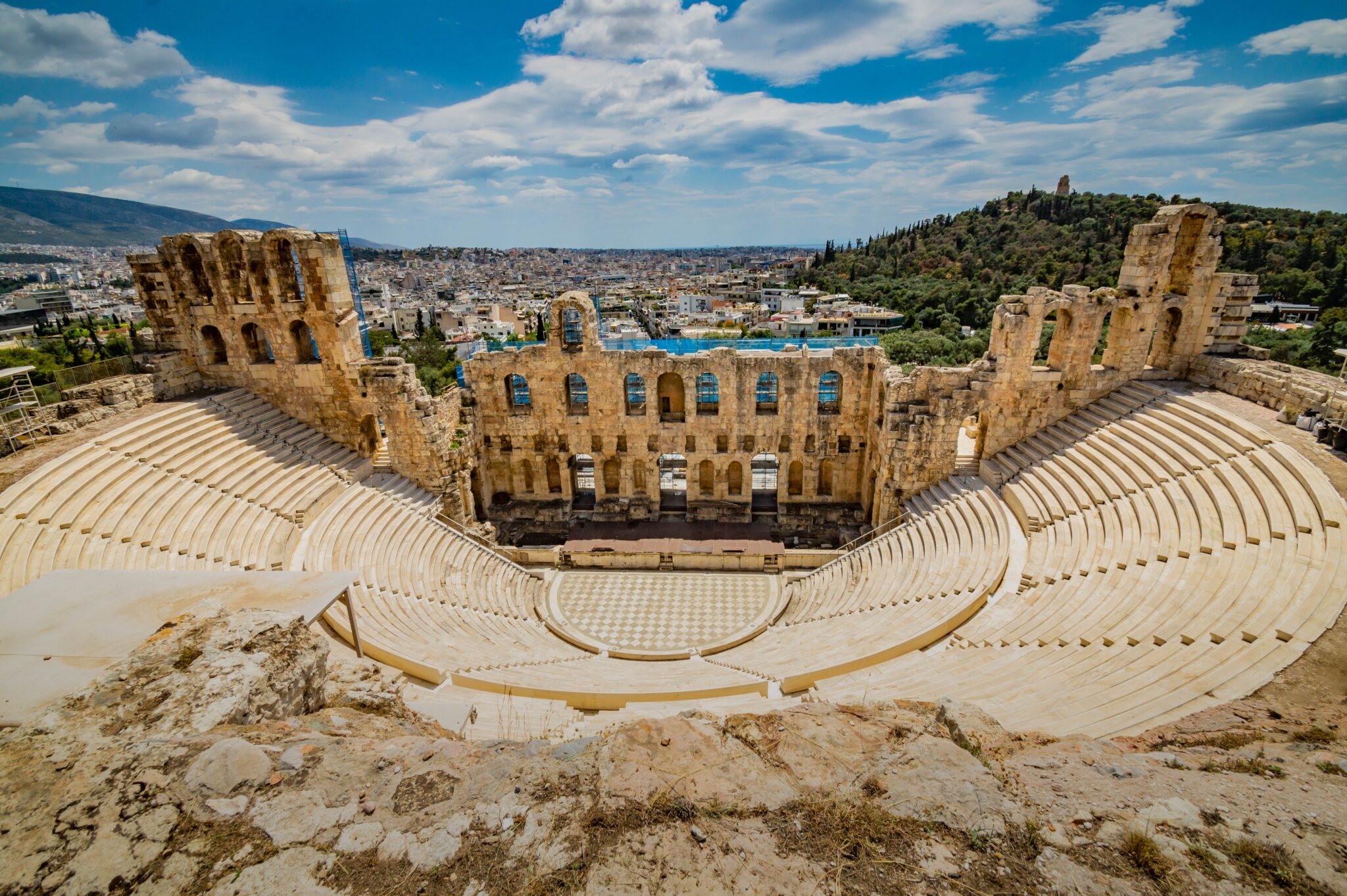
The Odeon of Herodes Atticus, commonly known as the Herodeion, is an ancient Roman-era odeon located on the southwestern slope of the Acropolis of Athens, at the western edge of the South Slope. It was the third to be built in ancient Athens, after Pericles’ Odeon, also on the South Slope (5th century BC), and Agrippa’s Odeon in the Ancient Agora (15 BC). It was constructed during the 2nd century AD, funded by Tiberius Claudius Atticus Herodes, a prominent member of an influential Athenian family and a benefactor, in memory of his wife Regilla, who passed away in 160 AD. The exact construction date is uncertain, but it is certain it was built between the death of Regilla and the 174 AD visit of the traveler Pausanias, who mentions the monument with great admiration.
The odeon, primarily used for musical events, was roofed and had a seating capacity of 5,000 people. It was a robust structure, but its walls were not solid. Porous stone blocks formed the two outer faces of the walls, while the interior was filled with uncut stones. The cavea (seating area) was semicircular, with a diameter of 76 meters, and was carved into the rock. It was divided into two sections by a central aisle, 1.20 meters wide, with 32 rows of marble seats. The upper level of the cavea was likely shaped into a surrounding colonnade. The orchestra, with a diameter of 19 meters, was also semicircular and paved with marble slabs. The stage was elevated, and its wall, preserved to a height of 28 meters, was divided into three levels. The upper part featured arched openings, while the lower part had three-columned projections and niches for statues, according to the Roman theater tradition. There were stairways on both sides of the stage leading to the upper seating area. In front of the external stage wall, there was a colonnade, the paraskenia. Mosaics with geometric and linear patterns covered the entrances of the staircases and the paraskenia. The construction of the monument was particularly costly, which is highlighted by ancient accounts mentioning the use of cedar wood for the roof. The roof of the cavea, with a radius of 38 meters, did not have internal supports, as no traces of them remain, which remains an architectural achievement even by today’s standards. On its eastern side, the odeon was connected to the Stoa of Eumenes, a covered building constructed about three centuries earlier by Eumenes II, the King of Pergamon (197-159 BC).
The odeon was destroyed in 267 AD by the Herulian invasion, which burned and destroyed many buildings in ancient Athens, and was never rebuilt, unlike other structures that suffered damage. In later years, the odeon was incorporated into the city’s fortifications. Its southern wall was integrated into the late Roman city wall, rebuilt in the 3rd century AD, and in the 13th century, the tall stage wall was incorporated into the wall surrounding the Acropolis hill’s base, known as the Rizokastro. In the 14th century, the earth covering the lower part of its southern wall was so thick that the entrances were no longer visible, leading the Italian traveler Niccolo da Martini to describe it as a bridge. During the 1826 siege of the Acropolis by the Turks, French philhellene general Fabvier and his soldiers used the Herodeion as an entry point to supply the besieged Greeks with food and gunpowder. Excavations in the monument area took place in the mid-19th century by the Archaeological Society and archaeologist C. Pittakis, removing large amounts of soil.
After the Greek War of Independence, the newly established Greek state sought to emphasize its identity by promoting continuity with ancient Greece, leading to calls for the cultural and economic exploitation of ancient theaters. Already in 1867, the recently excavated Herodeion hosted the first performance of ancient drama. In 1898, 1900, and 1922, various conservation and restoration works were carried out. Meanwhile, the historical space began to be regularly used for performances and public events. In September 1920, the Victory Celebrations of the Greek Army in Asia Minor were held there: in the presence of Venizelos and many officials, the Symphony of Glory by Kalomoiris was performed. The establishment of the Professional Theater School in 1924 led to the permanent establishment of the Herodeion as a venue for ancient drama performances, and the Delphic Festivals of the Sikellian couple (1927, 1930) gave new momentum to this cause. With the establishment of the National Theater in 1932, research on the interpretation of ancient drama was systematized. In 1936, the Metaxas Government established annual “festival periods” with performances of ancient dramas in outdoor theaters, and the National Theater constructed wooden seats in the lower section of the Herodeion. The strong public opposition by architect and urban planner Konstantinos Doxiadis to proposals for the full “marble restoration” of the ancient odeon only temporarily delayed the intervention. During the German Occupation, the Herodeion hosted concerts by the State Orchestra of Athens as well as performances by the newly formed National Opera, with young Maria Callas, then still Maria Kalogeropoulou, performing in Fidelio by Beethoven and The Master Builder by Kalomoiris.
In 1947, while the final battles of the Civil War were still being fought, the Archaeological Council decided to restore the floor of the odeon in marble and fully restore its interior and exterior to better accommodate modern performances. The National Theater undertook the funding, with the National Opera and the State Orchestra of Athens participating. The general technical and scientific oversight of the work was conducted by Professor Anastasios Orlandos. In 1952, the Archaeological Society took over the financing of the ongoing work. At the same time, the public road leading from the Makrygianni area to the square in front of the Herodeion was shifted further south, and the entertainment centers located there were removed. The existing access was redesigned as part of the overall landscape design around the Acropolis, meticulously planned by architect Dimitris Pikionis. This consisted of a wide monumental marble staircase, with irregular landings, leading from the current level of Dionysiou Areopagitou Street to the plateau in front of the entrances to the Odeon. On either side, recesses or extensions were created, producing a “picturesque” dialogue connecting the archaeological site, while the surrounding excavated area was planted with Mediterranean shrubs and trees.
The decision of Prime Minister Konstantinos Karamanlis to establish the Athens Festival found the Herodeion, built by Herodes Atticus in memory of his beloved wife, almost ready to welcome the officials. After a long prehistory of ideological obsessions with Greek identity, it finally found institutional expression, and the restored Herodeion provided the perfect venue. The opening of the festival took place in August 1955, though the restoration of the upper seating area had not yet been completed, and the surrounding landscape was still bare, dotted with newly planted shrubs. After the marble restoration was completed, with the exception of the areas above the corridors that had been damaged, the cavea of the Herodeion could accommodate 4,680 spectators, 120 fewer than in antiquity. Much later, the plaza in front of the entrances to the Odeon was paved.
Over the 52 years of the Athens Festival, the Herodeion stage hosted nearly all the major names, both international and domestic, in serious music, dance, and theater during the postwar years. During the first three decades of its operation, the festival provided the Athenian audience with an invaluable seasonal connection to Western artistic trends and offered Greek creators a prestigious platform.