Half-day excursions
The Erechtheion: A Temple of Unique Architecture and Mythological Significance
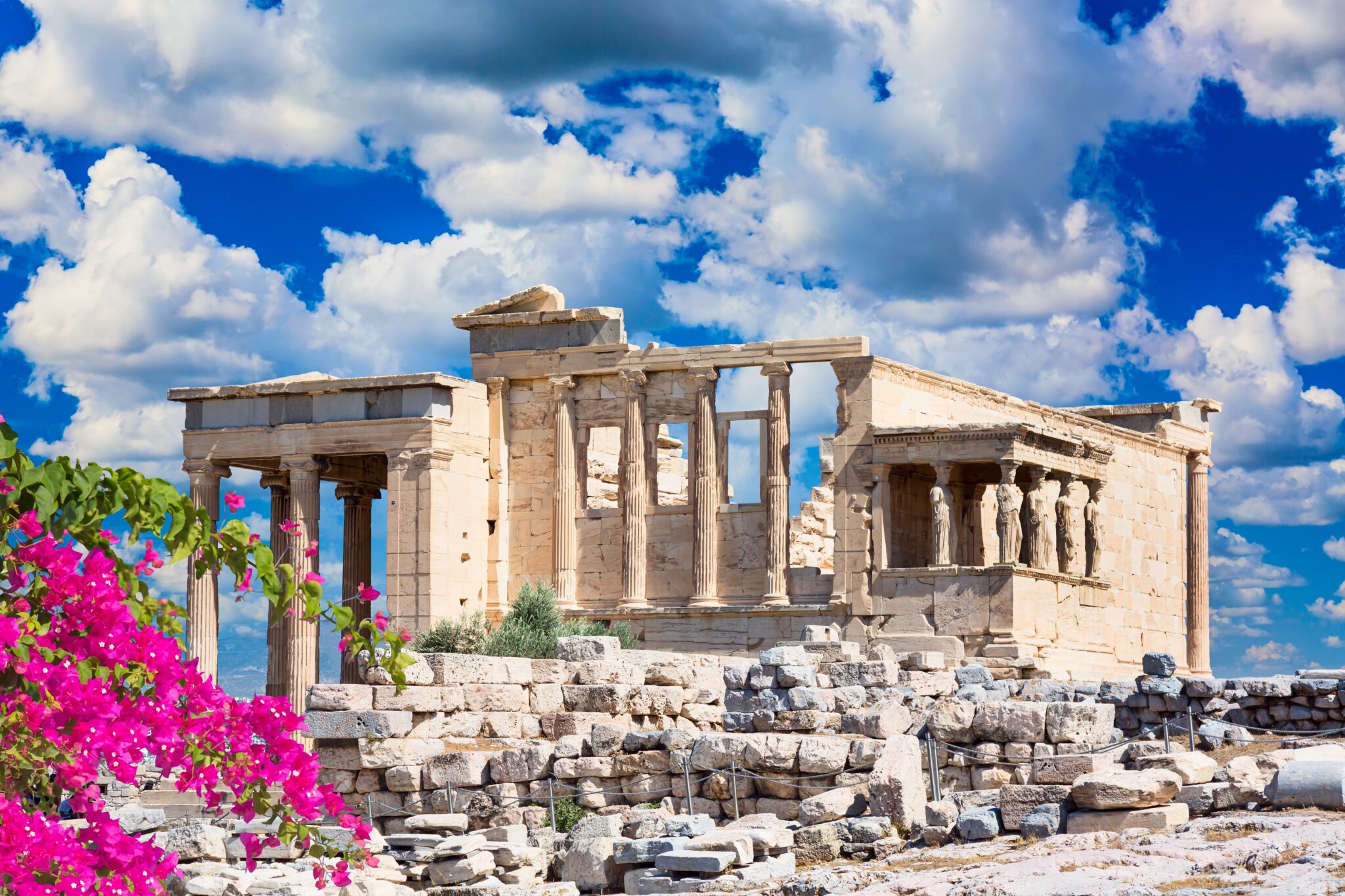
The Erechtheion is a refined structure with a distinct character and architectural form, located on the northern side of the Acropolis hill. It was constructed between 421 and 406 BCE, replacing an earlier temple dedicated to Athena Polias, known as the “Old Temple,” which stood slightly to the south.
The temple is referred to as the “Erechtheion” only by Pausanias (1.26.5), and its name is associated with the mythical king of Athens, Erechtheus, who was originally worshipped in this location. Other sources simply refer to it as the “temple” or “ancient temple.” Its unusual form is due, in part, to the unevenness of the terrain, with the eastern part being three meters higher than the western part. Additionally, the temple needed to accommodate two major cults in different spaces.
The first was dedicated to Athena Polias and occupied the eastern section of the building. In the western section, which was on a lower level, the cult of Poseidon-Erechtheus was practiced, and altars to Hephaestus and Butes, brother of Erechtheus, were located here. According to myth, this was also where the sacred serpent of Athena, the “oikurous ophis,” resided. Several sacred locations, such as the tomb of Cecrops and traces related to the dispute between Athena and Poseidon over the guardianship of the city, had to be protected by the temple.
The Erechtheion was constructed from Pentelic marble, with the frieze made of gray Eleusinian stone and the foundation built with Piraeus limestone. The eastern façade of the temple features a six-columned Ionic portico, which served as the entrance, with two windows on either side. Inside, the statue of Athena, made from olive wood and clothed with a peplos by the Arrephoroi during the Panathenaic festival, was kept. In the western part, a P-shaped propylaeum led into the temple, with four Ionic columns on the front and one on each side. According to tradition, the floor of the propylaeum contained the marks of the trident with which Poseidon struck the earth, causing the salty spring to flow.
The temple’s floor was made of marble, and beneath it, according to tradition, was the “Erechtheian sea,” where the waters of Poseidon’s salty spring ended. A small door on the western wall of the temple led to the sanctuary of Pandrosos, located to the west of the Erechtheion. The western side externally had four Ionic columns on a tall stylobate, connected by a low wall and railings. A door on the southern wall led via a staircase to the Porch of the Caryatids. This small portico, shaped like a “P,” had six statues of young women, or “caryatids,” who supported the roof with their heads.
The term “Caryatids” was later applied because the figures were associated with the maidens from the town of Caryae in Laconia, who danced in honor of the goddess Artemis. The Caryatids were sculpted by the artist Alkamenes or, according to some, by Callimachus. Five of the Caryatids are now in the Acropolis Museum, while the sixth is in the British Museum. Replicas made of cast material have been placed in their original locations. The entire temple was decorated with a frieze, which likely depicted scenes related to the mythical kings of Athens.
In the 1st century BCE, the monument was burned during barbarian invasions and underwent minor repairs and modifications. During the early Christian period, it was transformed into a church dedicated to the Mother of God. During the Frankish period (1204–1456), it was used as a palace, and during the Ottoman period (1456–1833), it housed the harem of the Turkish governor. In the early 19th century, one of the Caryatids and a column were removed during the looting of the Parthenon marbles by Lord Elgin. Shortly afterward, in 1827, during the Greek War of Independence, the building was destroyed by a Turkish shell.
Efforts to restore the monument began immediately after Greece’s liberation. The Erechtheion was the first of the Acropolis monuments to undergo complete restoration, which was completed between 1979 and 1987 as part of the restoration work on the Acropolis. This restoration won the Europa Nostra Award.