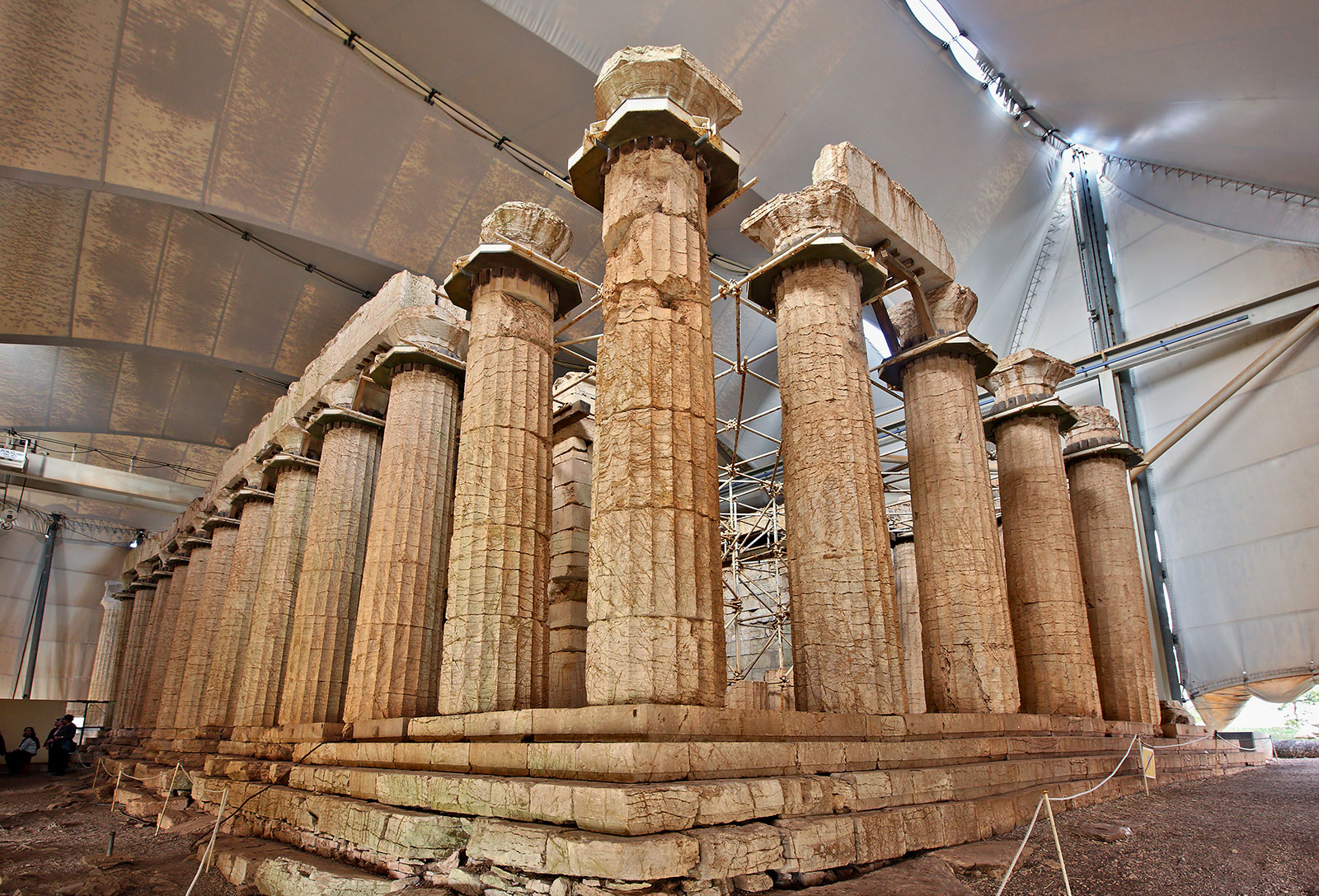
The Temple of Apollo Epicurius was the first Greek monument to be included in the UNESCO World Heritage List in 1986 with the following commentary: “The famous temple dedicated to the god of the sun and healing of diseases was built around the mid-5th century BC on the highlands of the Arcadian mountains. The temple, with the oldest Corinthian capital ever found, combines archaic style and Doric order with certain innovative architectural elements.”
Temple of Apollo Epicurius
The “Parthenon” of the Peloponnese!
In the heart of the Peloponnese, in Bassae of ancient Figaleia, at an altitude of 1,130 meters, stands the majestic and ever-greening Temple of Apollo Epicurius.
The architect and creator of the temple is believed to be Ictinus, a great architect of antiquity who, along with Callicrates, designed the Parthenon. This universal architectural jewel was the first of Greece’s magnificent monuments to be recognized by UNESCO as a World Heritage Site in 1986. You can reach the temple from Ilia, through a mesmerizing route beside the river Neda, or from Tripoli and Megalopolis.
Bassae has always been a revered site, hosting numerous temples. The name of the area means “small valleys.” Indeed, the mountains of the Peloponnesian land create a captivating terrain, and among them rises the imposing landscape of the temple. The mountains of Kotylion, Lycaeon, Tetrazio, and Elaio stand protectively around the Bassae valley. In this natural sanctuary, all the gods of antiquity were worshiped—Pan, Aphrodite, Artemis, and, of course, Apollo, as Bassitas and Epicurius (the helper). Here, one of the greatest worship centers of the entire Greek world was destined to be built.
Strength, Beauty, and Harmony
The temple, in its present form, was constructed between 420 and 400 BC. Archaeologists are convinced that an earlier temple, probably from the 7th century BC, lies beneath it. The newer temple, this unique monument by Ictinus, encapsulates all the architectural knowledge of Greek civilization in its structure.
With archaic elements, as well as significant innovations, it became the subject of admiration for all travelers throughout the centuries. Pausanias, who arrived at Bassae in the 2nd century AD, was amazed by its grandeur and power. It is believed that the central column of the temple reflected the first ray of the summer solstice, representing the eternal Apollonian light. If this is true, it would make it the first iconic, abstractly conceived statue in human history.
When Man Creates God
Ictinus thoroughly studied the surrounding area when undertaking the construction of the temple. For its construction, he preferred to use the gray limestone, a material native to the region. This choice resulted in the temple appearing as a natural element of the landscape—self-sustaining and eternal. The proportions of its length and width were calculated in such a way that the massive size of the temple is balanced by the grace it exudes. Light itself was used by the great artist as a structural element of the temple. The play of light and shadow initially creates the illusion that the temple is smaller than its actual size, but as one gets closer, its true dimensions are gradually revealed. In this way, the monument does not impose itself with its bulk, while exuding power and awe when one stands near it. At the same time, it creates an evolving relationship with the god Apollo himself, as light is the primary factor in this gradual revelation.
The temple’s external elements are strictly Doric. Inside, the sculptural compositions and architectural decoration are of unparalleled art and beauty. The central column, which dominates the temple, is Corinthian in style, and its capital is the oldest surviving example of this type. The significant frieze of the temple, depicting scenes of Heracles, the Centaurs, and the Amazons, is now housed in the British Museum.
The temple remained in use throughout the Hellenistic and Roman periods. In 1765, following Pausanias’ guide, the French architect J. Bocher managed to identify some findings with the important sanctuary of Apollo.
The first systematic excavations began in 1812 by a group of prominent European archaeologists and continued in 1902 by the Archaeological Society of Athens, under the archaeologists K. Kourouniotis, K. Romaio, and P. Kavvadias. Thus, this brilliant achievement of Greek civilization was restored to humanity in all its glory!
Extra Tip: