Half-day Excursions
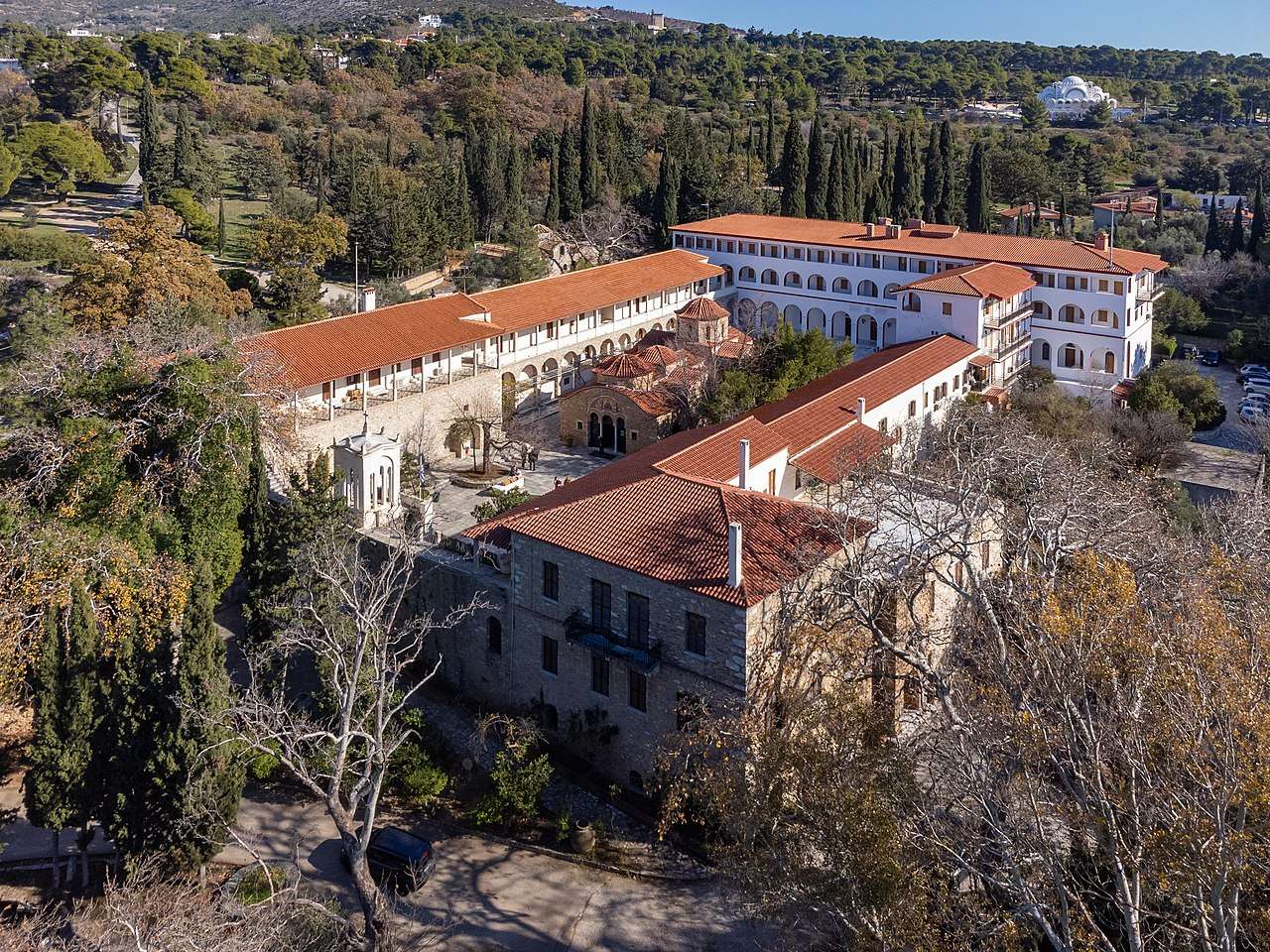
The Holy Monastery of the Dormition of the Theotokos Penteli, also known as the Monastery of Penteli, is a historic male monastery located on the southern side of Mount Penteli in Athens. It currently belongs to the Archdiocese of Athens.
The Monastery was built in 1578 by Saint Timothy, the Bishop of Euripus, who was originally from Attica and had fled his diocese due to persecution by the Turks. When Saint Timothy sought refuge on Mount Penteli, he found that the mountain was inhabited by persecuted, literate, ascetic clerics, living in areas where water was available (and there was plenty of water in many parts), allowing them to cultivate small gardens. After persuading them to build a monastery, they began to search for a location at the foot of the mountain. They soon discovered the bones of a deceased hermit, along with a small icon of the Virgin Mary, and decided to build the monastery there. According to another tradition, the monastery was built over the ruins of the ancient municipality of Penteli from the Antiochian tribe (one of the ten tribes of Ancient Athens) and a sanctuary dedicated to the goddess Athena. During the relatively short time that Saint Timothy served as abbot, part of the Katholikon (the main church), the southern side of the monastery, and the fortified tower at the main gate were built.
After 1580, following the departure of Saint Timothy, scandals and disputes arose among the monks, leading to the intervention of the Metropolitan and the local council of Athens. Following this, the deacon Hierotheos Degleris became the abbot, later donating his own property to the monastery. His attempt to bring order to the monastery was met with opposition from the “Penteliot Brotherhood,” who considered him an outsider. During his tenure, he managed to obtain a sigillium (patriarchal document) from Patriarch Jeremiah II, declaring the monastery as an independent stavropegic (directly subject to the Patriarchate, not the local bishop), free from the intervention of the local ecclesiastical leadership. This remained the case until the end of the Turkish occupation in 1833, except for a brief period between 1702 and 1713, when the monastery lost its stavropegic status.
In his efforts to consolidate power within the monastery, Hierotheos made the abbacy hereditary, a unique move that was accepted, although the monastery was never considered the private property of the Degleris family, despite the hereditary system lasting for approximately 300 years, until 1884. The successor, the nephew of the abbot, began his education at the monastery from the age of 10 to 12, ensuring he was familiar and accepted by the community of monks.
Hierotheos increased the monastery’s wealth by purchasing the Vourvas estate in Marathon, and his successor, Abbot Arsenius I Degleris, planted hundreds of olive trees in the Akamatika region of Gerakas. The monastery’s power grew, along with its expansionist tendencies, which became a threat to the neighboring smaller Monastery of Saint Nicholas of Kalission (or Kalission), which succeeded in merging with the powerful Monastery of Pantokratoros, known as “Daou Pentelis,” through a sigillium issued by the Ecumenical Patriarchate in February 1602.
By 1650, the basic structure of the monastery was completed, with the Katholikon acquiring a narthex and frescoes.
After 1660, the abbey secured tax exemptions from the mother of the Sultan, Turhan Hatice Sultan, in exchange for sending 3,000 okas of honey annually to the Yeni Mosque in Constantinople, which would be distributed to the poor during Ramadan. The honey shipment was later increased to 4,000 okas when the Monastery of Pantokratoros was annexed to Penteli. The monastery also sent a symbolic 25 okas of honey annually to the Ecumenical Patriarchate. In 1678, during the patriarchate of Dionysius IV, the hereditary right to the abbacy by the Degleris family was formally confirmed with a patriarchal sigillium and remained in place until 1884. The last abbot from the family was Joseph Hountas (1881-1884).
In 1680, on Easter Day, the Monastery of Pantokratoros was raided, possibly by Algerian pirates, resulting in the death of almost all of its monks (179 monks were lost). Following this disaster, the Monasteries of Pantokratoros and Saint Nicholas of Kalission were merged into the Monastery of Penteli, along with all their property. By the end of the 17th century, the monastery reached its peak, owning most of Penteli, becoming the largest non-Muslim landowner in Attica, securing ecclesiastical independence from the Patriarchate, and obtaining additional tax exemptions from the Ottoman authorities.
In the early 18th century, during the patriarchate of Gabriel III (1702–1707), the stavropegic privilege was abolished, and the monastery was placed under the jurisdiction of the Metropolis of Athens, a measure aimed at increasing the resources of the Athens metropolis, which had suffered under Venetian occupation. However, due to the favorable relationship the monastery had with Constantinople, it was able to regain its stavropegic status through a sigillium from Patriarch Cyril IV (1711–1713). During this period, the monastery acquired the Church of Saint Irene in Athens, which, however, was not included in the stavropegic privilege from 1716, as per a sigillium issued by Patriarch Jeremiah III.
In 1750, Abbot Hierotheos II Degleris used his influence with the Ottomans to grant permission for a school initiative supported by the brothers Michael and Ioannis Dekas, along with the hieromonk Vissarion Roufos.
Throughout the 18th century, the monastery’s landholdings continued to grow through new purchases and donations. In 1768, Abbot Nikiforos renovated and expanded the monastery. During this period, the narthex was likely added to the Katholikon. Under Abbot Nikiforos, land was purchased in Megalo Vraona and Chalandri, and the monastery’s holdings in Gerakas were expanded. In November 1797, the monastery acquired the Alegriza estate, and in April 1800, it bought land with olive trees in Chalandri. Later, under Abbot Cyril I Degleris (1807–1821), the monastery acquired the Petreza estate and the large Velanidiza estate in the Mesogeia region, where a large number of olive trees were planted. One of the most important dependencies of the monastery was that of “Agia Dynami” in Athens, which had an underground crypt that was used during times of insecurity. At that time, it also served as a temporary residence for the rural and clerical visitors from Attica.
During the Greek War of Independence in 1821, the monastery played an active role, with its monks fighting and falling in battle, while the Turks caused vandalism and destroyed its library.
The monastery was renovated in 1768 and 1858. Above the entrance to the guesthouse, there is an inscription indicating that the monastery was repaired and expanded under the abbacy of Hierotheos IV Mitrofanous (1885–1897 and 1900–1903) in 1885, during the tenure of the Minister of Ecclesiastical and Public Education, Antonios Zykomalas.
From the late 18th century, especially after 1830 with the establishment of the new Greek state, the Turks of the region began selling their properties, much of which was purchased by the Monastery of Penteli. The lands owned by the monastery were leased to farmers, who were required to pay one-third of the yield to the monastery. In 1923, the state purchased lands from the monastery to distribute to farmers, who could repay in installments. By 1931, the monastery owned more than 210,000 stremmas (a Greek unit of area) in Attica. In the area of Vourva in Spata alone, it owned 35,000 stremmas.
From 1945 to 1956, the abbot of the Monastery of Penteli was the Pontian priest, Father Iakovos Makrygiannis, later Metropolitan of Elassona.
In 2013, the Ministry of Culture began restoration work on the monastery’s buildings and the creation of an exhibition center. Today, the monastery has transformed its old old-age home, which was shaped like a church, into a museum to display its relics. It also has a library, and on the eastern side, the Orthodox Center of the Church of Greece has been operating since 1969.
The current abbot is the titular Metropolitan of Thermopylae, Ioannis Sakellariou. As of now, the monastery’s monastic registry lists 58 monks, one novice, and 17 monks live there.
The monastery celebrates the Feast of the Dormition of the Theotokos on August 15 and the Feast of Saint Timothy, its founder, on August 16, as well as the Monday after Pentecost.
The monastery’s Katholikon is a cross-in-square church with a dome. Over time, it was expanded into a three-apsed shape, following the architectural style of Mount Athos. The church was renovated in 1768 and 1858, and extensive alterations were made in 1953. The frescoes of the church are believed to have been created by the iconographer Dimitrios Kakkavas (1600-1635), while the Pantokrator in the dome is a later work from around 1750. The icons of the altar and the iconostasis were painted by Fotis Kontoglou, and the icons of the narthex were painted by Rallis Kopsidis (1971–1973). The frescoes of the church were cleaned and restored in 1971 and again in 2015.