Half-day excursions
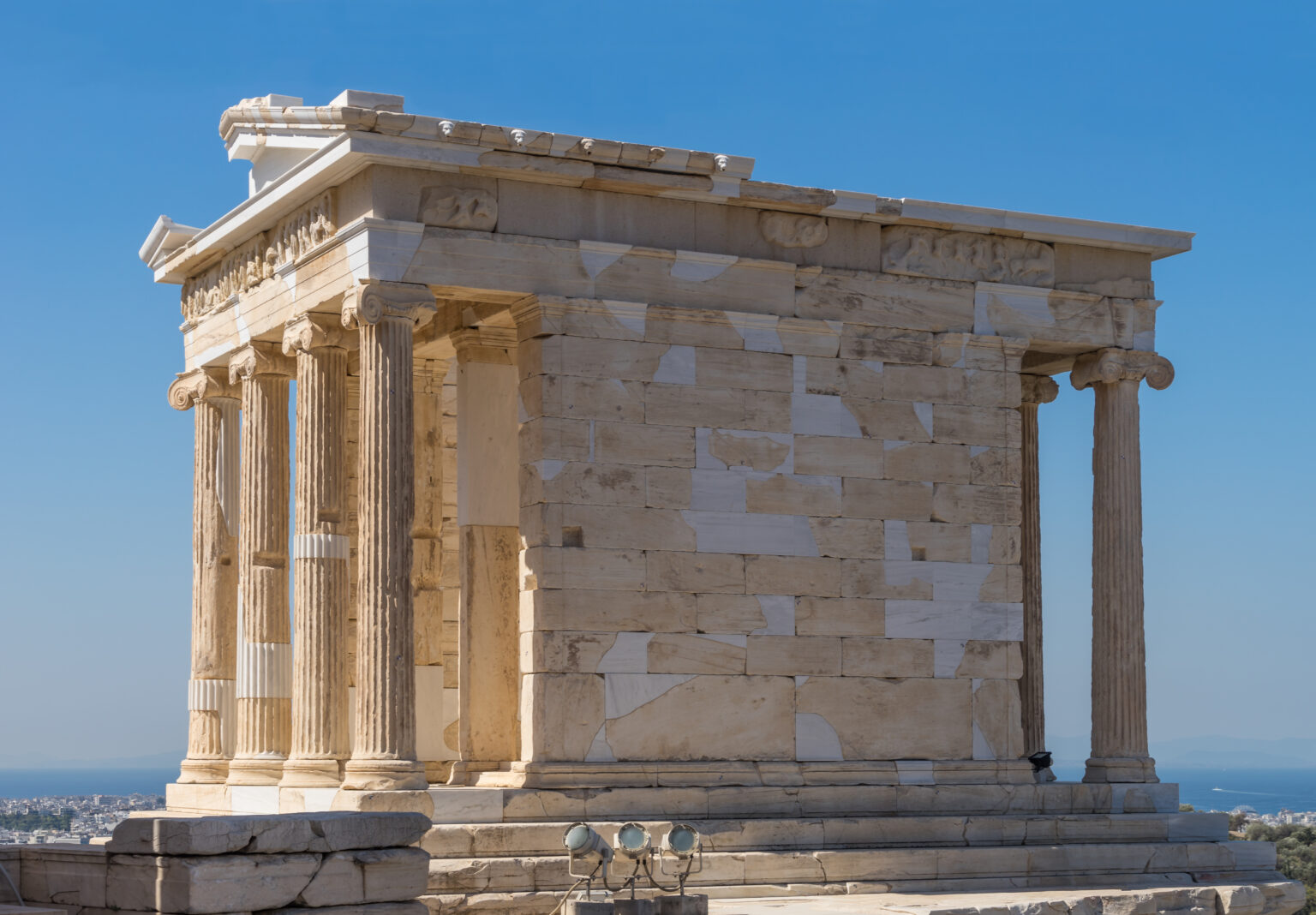
The Temple of Athena Nike is located on the southwestern side of the Sacred Rock of the Acropolis, at the spot where the Mycenaean-era tower, which protected the entrance to the Acropolis, once stood. The classical temple was built between 426-421 BC, based on designs by the architect Kallikrates. It is the successor of earlier temples also dedicated to Athena Nike. The first temple, which dates back to the mid-6th century BC, was wooden and was destroyed by the Persians in 480 BC.
During the same period, the “eschara,” a kind of altar, was built, possibly serving as the base for the ancient wooden statue of the goddess. In the era of Kimon, around 468 BC, a new small temple made of porous stone was constructed, incorporating the base of the statue, along with a new altar outside the small temple. The foundations of earlier altars and temples have been preserved beneath the floor of the classical period temple within the tower. The traveler Pausanias (1.22.4) refers to the temple as the Temple of Wingless Victory, and he mentions the tradition that the goddess was depicted without wings to remain forever in Athens.
In addition to the worship of Athena, the area also had older religious practices. Already in the Mycenaean era, there was a small double-apse sanctuary on the western side of the tower, and before the classical period, the eastern part contained sanctuaries of the Charites and Hecate Epipyrgidia.
The construction of the classical Temple of Athena Nike was part of the large building program on the Acropolis during the era of Pericles. Significant information about its construction comes from inscriptions, mainly decrees by the Athenian people, which refer to the project.
The temple that we see today was built on top of the tower, which was appropriately modified for this purpose. The old Mycenaean tower was faced with carefully constructed porous stone walls built in the isodomic system, which made its shape larger and more regular, culminating in a rich superstructure.
The temple is small, in the Ionic style, amphiprostyle, with a series of four monolithic columns on each narrow side. It has no pronaos, only a small cella, whose side walls terminate in pilasters with two antae between them. The spaces between the pilasters and the antae were closed with railings, as were the spaces between the pilasters and the corner columns, giving the impression of a small pronaos. Above the architrave, the temple has a frieze designed by the sculptor Agoracritos.
On three sides of the frieze, scenes from battles between Greeks and Persians, as well as Greek hoplites fighting other hoplites, are depicted, while the eastern side shows the Olympian gods observing these battles. Very few fragments of the pediments have been preserved. It is assumed that the western pediment depicted the Gigantomachy and the eastern one the Amazonomachy. The altar was located to the east, outside the temple. In 409 BC, a marble parapet, approximately 1 meter in height, was constructed at the edge of the tower to protect the worshippers. This parapet consists of relief plates depicting winged Victories sacrificing or leading bulls to sacrifice, decorating trophies, and the goddess Athena seated, watching these scenes. Several of these parapet reliefs, as well as parts of the frieze, can be admired in the Acropolis Museum, while other parts of the frieze are housed in the British Museum.
The temple was preserved for many centuries and was converted into a church in the 5th century AD. During the Ottoman period, its interior was used as a gunpowder storehouse, but in 1686 AD, the Ottomans, in order to counter the Venetians under Morosini, demolished it to use its building material for the construction of the fortification wall in front of the Propylaea, where they also built a high tower known as the “Koula.”