Half-day excursions
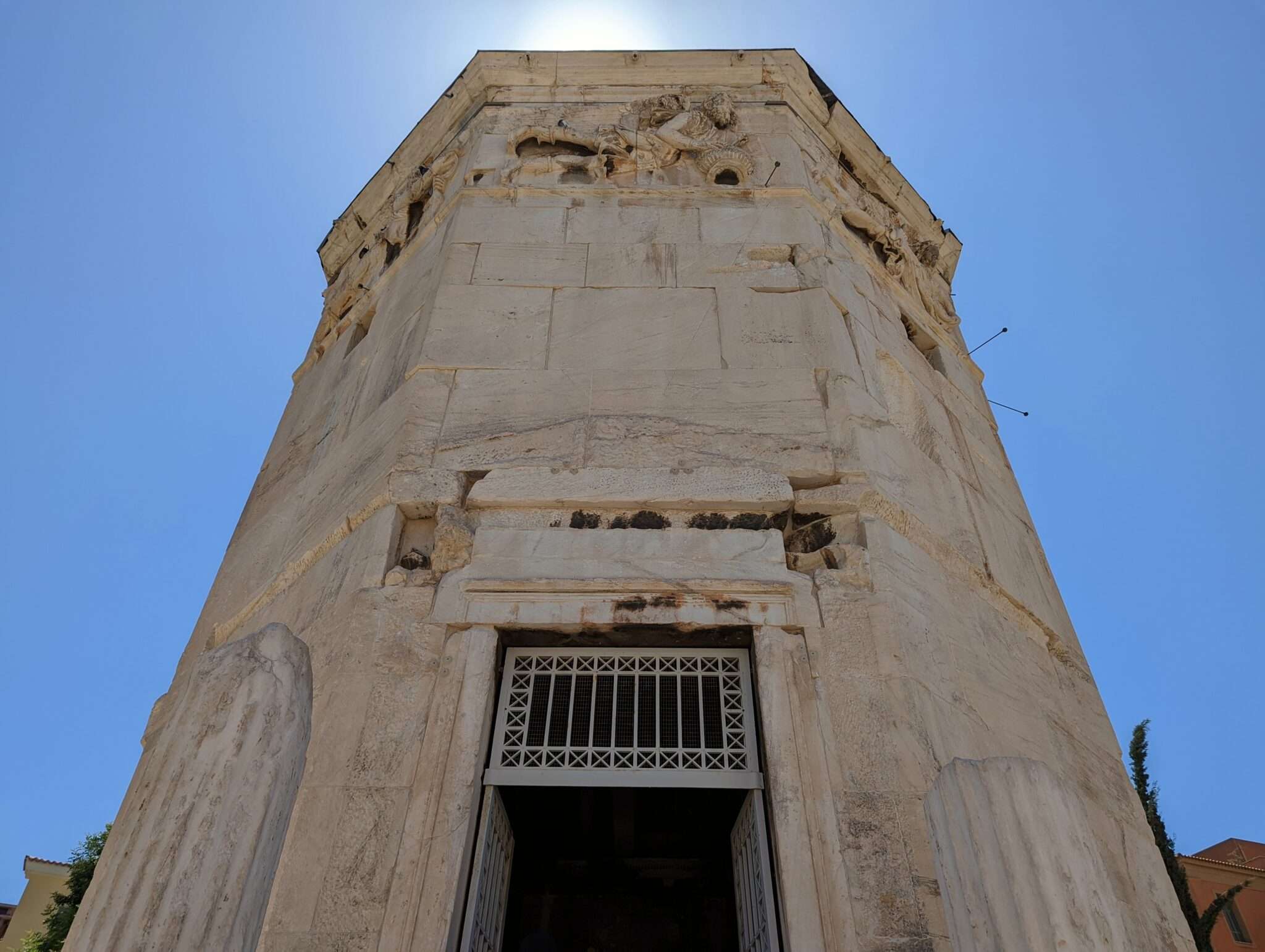
The Tower of the Winds, also known as the Horologion of Andronikos Kyrrhestes, is one of the most charming archaeological monuments of Athens. It is located in the Roman Agora, in the Plaka area, and is considered the first meteorological station in the world! Built entirely of Pentelic marble in the first half of the 1st century BC by the Greek astronomer Andronikos of Kyrrhos (or Cyrrhus) from Macedonia (or Macedonian Syria), it has an octagonal shape.
Its total height reaches 12 meters, with each side measuring 3.20 meters. The conical roof was adorned with a bronze Triton, which acted as a weather vane. However, the most impressive feature of the monument is undoubtedly the eight reliefs of winds on the metopes of the sides, each representing a different winged wind, bearing a unique symbol, and accompanied by their names. These are Boreas (North), Caecias (Northeast), Apeliotes (East), Eurus (Southeast), Notos (South), Lips (Southwest), Zephyrus (West), and Skiron (Northwest).
The monument fascinated travelers and historians for both its construction and its scientific use. It was called the Tower of the Winds or the Temple of Aeolus, and has been described in great detail. It is classified in two architectural styles: the exterior, with columns at the two propylons, follows the Corinthian order, while the interior is in the Doric style.
Apart from being a meteorological station, it also served as a horological station, as it had external sundials, and on days without sunlight, a water clock functioned inside. It is believed that the builder of the monument combined the inventions of previous clockmakers, such as Archimedes, Ctesibius, and Philo.
During the early Christian period, it was converted into a church or a baptistery for a nearby church, and a Christian cemetery existed outside the northeast entrance. In the 15th century, the monument was referred to as the Temple of Aeolus and was described as a church by an anonymous traveler. In the 18th century, it was used as a tekke (Muslim monastery) by the Dervishes, who, according to one version, saved it from being dismantled and transported to Great Britain by Lord Elgin.
It was fully excavated in the 19th century by the Greek Archaeological Society, and since then, the area surrounding it, known as “Aērides,” has developed into one of the most picturesque spots in the historical center of Athens.