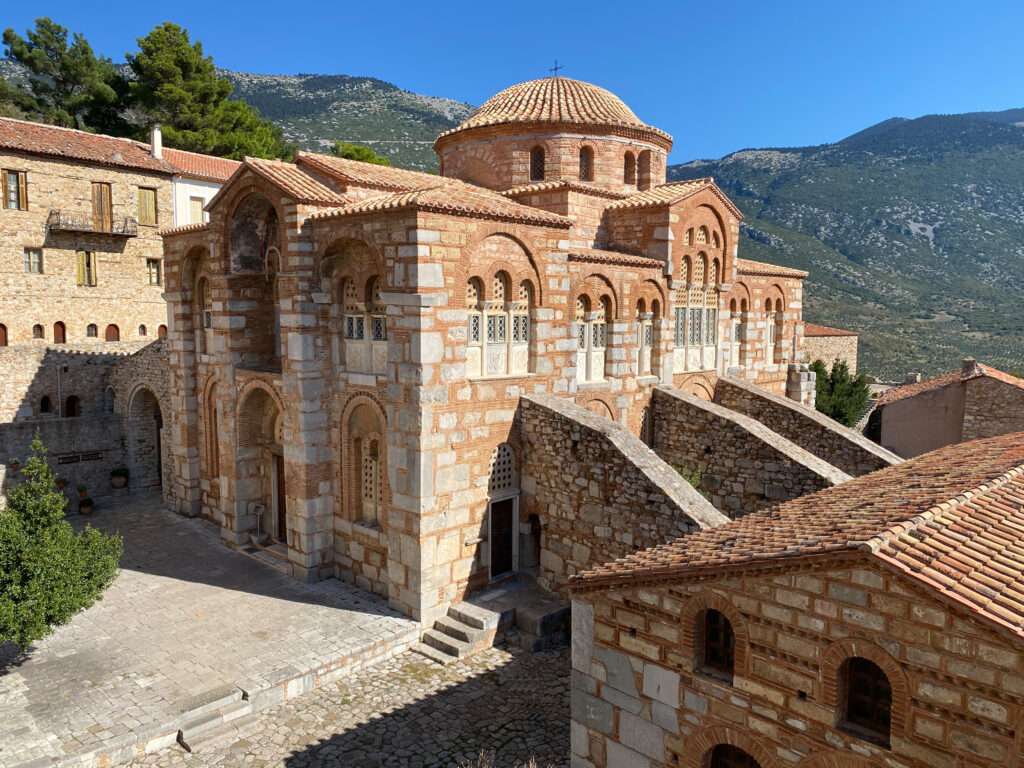
Monastery of Hosios Loukas
The Monastery of Hosios Loukas, the Hagia Sophia of Roumeli, is located in the municipality of Stiri, in the municipal unit of Distomo, in the municipality of Distomo-Dragonas-Antrikeras, in the regional unit of Boeotia, Central Greece. It is situated at an altitude of 430 meters on Mount Stiri. It is one of the most important monuments of the Middle Byzantine art and architecture and is included in the UNESCO World Heritage List, together with the other two surviving Middle Byzantine monasteries in Greece, Nea Moni and Dafni Monastery. However, Hosios Loukas is larger and differs from Dafni and Nea Moni as it is dedicated to a unique saint, Hosios Loukas, who lived as a hermit on Mount Stiri (July 29, 896 – February 7, 953).
The Monastery of Hosios Loukas is located on Mount Stiri, at the site where the ancient temple of Stiriitis Demeter once stood. It is surrounded by a plateau covered with an olive grove, in a landscape untouched by time, unspoiled by urbanization or any other activity, maintaining its authenticity. Information about the history of the monastery comes from the life of Hosios Loukas, a work by an anonymous author from 962, which “bears the stamp of history,” as historian G. Kremos noted when he first published it in 1874 in Phocica. The biography, written in great detail after the saint’s death, was penned by an anonymous monk who was deeply knowledgeable about the situation and events of the time, a highly capable theologian, and an excellent scholar. It provides indisputable information about the church and monastery and gives historical testimonies about the major invasions of the Slavs, Arabs, Saracens, Bulgarians, and others, as well as the liturgies of the Dormition and the Translation of the saint’s relics, sources considered reliable by archaeologists. According to these sources, the founder of monastic life at the monastery was Hosios Loukas himself, who lived there during the last seven years of his life (946–953). He was born in Kastri, Phocis in 896, to parents who were refugees from Aegina. Early on, he embraced monasticism, and by the end of 910 or 911, he had become a monk in Athens. Later, he lived in various hermitages in Phocis and along the opposite Corinthian coast at Korfos in Corinthia. His movements were dictated by the threat posed by the Bulgarians of Symeon. In 946/947, he settled at the site of the present-day monastery and died in 953.
Hosios Loukas was a well-loved figure both among the local population and the officials of the Theme of Hellas, whose capital was Thebes. He carried out philanthropic and healing work and had the gift of prophecy. In 941, he had predicted the reconquest of Crete by General Nicephorus Phocas under Emperor Romanos II (961) with the prophetic words: “Romanos will conquer Crete.” These abilities and his posthumous fame contributed to the area’s pilgrimage significance. In fact, the general of the Theme of Crete financed the construction of a church during the saint’s lifetime in 946, the Church of Saint Barbara, which was completed after Hosios Loukas’s death. Hosios Loukas was buried on the floor of his cell, and in 955, monks built a cross-shaped structure around his tomb, along with the first cells of the monastic community.
There are varying accounts regarding the construction of a more magnificent church to house his relics. However, the Translation is generally placed around 1011, and the construction of the new katholikon (main church) is thought to have taken place when a certain Philotheos was abbot. By 1014, the monastery had flourished and owned two estates in Euboea, in Antikira and Saint Nicholas in Kampia, Boeotia. According to discussions suggesting that the monastery enjoyed imperial favor (either from Romanos II, Basil II, or Constantine IX Monomachos) due to its monumental architecture and rich decoration, the most plausible theory is the involvement of imperial workshops under Constantine IX, coinciding with a broader Renaissance of arts in the Byzantine Empire. Archaeologists disagree on the dating of the earlier buildings: Hadzidakis supports 1011 (under Basil II), while Stikas suggests 1042 (under Constantine IX).
After 1204 and the Frankish occupation of Greece, Latin monks inhabited the monastery, but during the Ottoman era, it returned to Greek hands. During the Ottoman period, after the Orlov Revolt in 1770, the monastery became a base for Andreas Verousis, who used it to gather supplies, treat the sick and wounded, hold Turkish prisoners, and prepare young men for the Greek War of Independence. It was a key base for his resistance efforts in the area. In 1780, after being invited by the voivode of Livadia to direct the local klephts, 3,000 Turks surrounded the monastery to surprise and capture him. Verousis, with his klephts and the monks, defended against the Turkish attacks for 12 days, barricaded in a tower of the monastery. Eventually, they managed to escape that night, with the help of monk Simeon Mastrogeorgis, without losing a single man. This enraged the Turks, who turned against the monastery, destroying it, beating the monks, stealing everything, and even shooting at the icons, while their leader committed suicide from the women’s gallery of the church. Long-term heavy taxes were imposed on the monastery. In 1790, Verousis left the monastery when he began working with Lambros Katsonis.
Later, until around 1800, the monastery served as a base for klephts and was a site of frequent clashes, this time under the leadership of one of Verousis’s last men, Georgios Ioannis Sideris, also known as Karkaletsis.
During the Greek War of Independence, the monastery was the starting point of the revolution in Roumeli. In mid-March 1821, the bishop of Salona, Isaías Desphiniotis, together with Athanasios Diakos, Vasilis Bougros, and the Filiki Eteria member Zareifis, decided and planned the start of the revolution, swearing an oath on the Gospel. On the morning of March 27, after Orthros, Isaías officially declared the start of the Revolution, raising the revolutionary flag for Roumeli. The monks then courageously joined the battle, capturing a Turkish officer and other Turks, forcing them to pass under the sword as a sign of submission.
In June 1822, Elijah Mavromichalis and Nikitaras gathered at the monastery under the orders of Odysseas Androutsos to return to the Morea after defending Livadia. Greek forces also regrouped here after the battles of Livadia.
Under the threat of Droumali in 1822, most of the monks left the monastery. Only three remained to protect and maintain the necessary religious rites. During the summer, the Turks looted the monastery for eight days before setting fire to the guesthouses. The remaining monks could not defend the monastery. A year later, the Turks returned, completely burning it down, including the ancient church and many important elements of the monastery’s history. After the looting, a plague spread among the Turks, which was seen as a punishment and miracle of Hosios Loukas.
Generally, due to its location, the monastery became a frequent target of attacks and clashes but also a refuge for klephts, brigands, and revolutionaries. Its contribution was not limited to providing material support, primarily food, where it was most needed, to warriors and locals.
On August 23, 2023, during a fire, some buildings of the monastery were burned, and the katholikon was also threatened. Despite suffering from destruction and looting throughout the centuries, the monastery still preserves a rare architectural and decorative wealth. Restoration efforts began in 1938 by the Archaeological Service and the Archaeological Society and continue successfully to this day.
The Church of the Virgin Mary, the oldest in the complex, is the only one known to have been built in mainland Greece during the tenth century. It follows the architectural type of the complex four-columned cross-in-square church with a dome, characteristic of the architectural school of Constantinople. The church was expanded with a spacious narthex and a unique exo-narthex with an open portico and two enclosed rooms at the ends. During restoration work, an excellent fresco was discovered beneath the marble floor of the katholikon, once adorning the eastern wall of the southern exo-narthex, depicting the Archangel Michael appearing to Joshua before the fall of Jericho.